I recently attended three weeks of intensive laboratory training on fecal hormone assays – okay, let’s be honest: poop analysis. If you’re thinking- eeuw, you are not alone. Before embarking on this PhD degree, collecting poop didn’t cross my mind. I mean, who thinks about poop, right? Except, hard-core dieters and maybe crazy scientists? And now I’m one of them, patiently waiting on batties to – em – crap so I can scoop it up, much to the surprise of the batties themselves. But guess what, there’s plenty of power in poo. Let me explain.
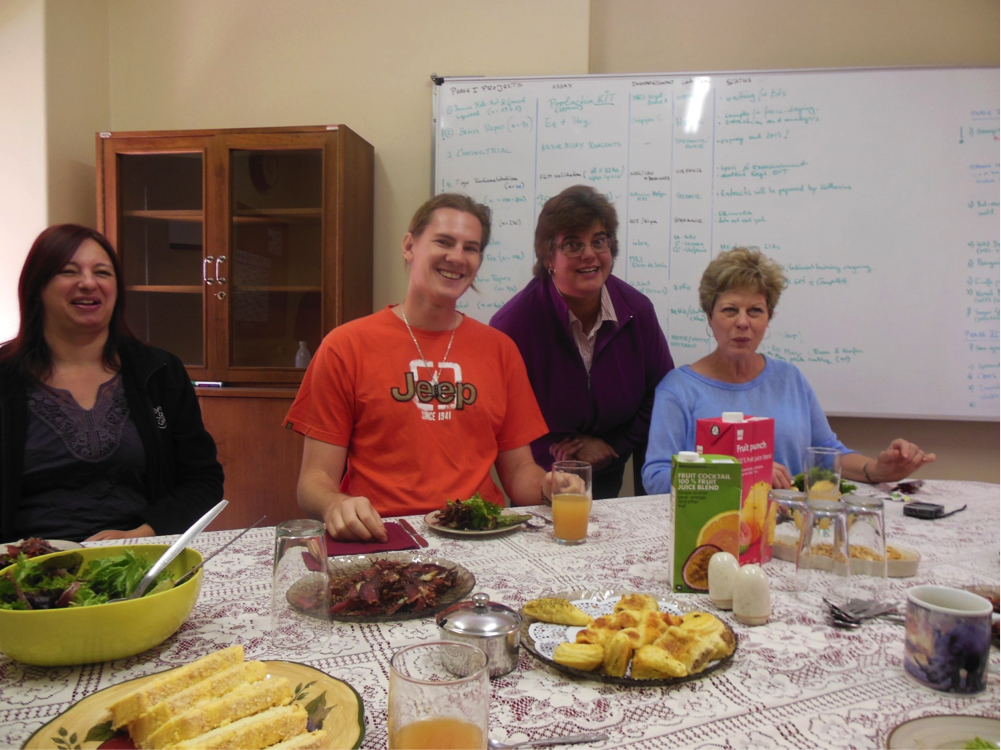
Lab work involves eating, naturally.
When stressed, an animal releases stress hormones into its system, which is commonly measured through blood extraction. But therein lies the catch: the very act of capturing and drawing blood from an animal is not only cumbersome but could contribute to further stress. And that’s not all; licensed personnel and strict ethical requirements are needed to carry out such operations. Thanks to recent advances in science, you can avoid all the above logistics by simply collecting poop. All you need do is wait for the animal to do its business – which in my case is pretty easy, since we spend time with them daily collecting behavioural data. The best part is that it’s a non-invasive and simple method of collecting scientific data without interrupting the animal’s normal activities. Once collected, it is crucial to freeze the samples immediately to prevent hormonal degradation.
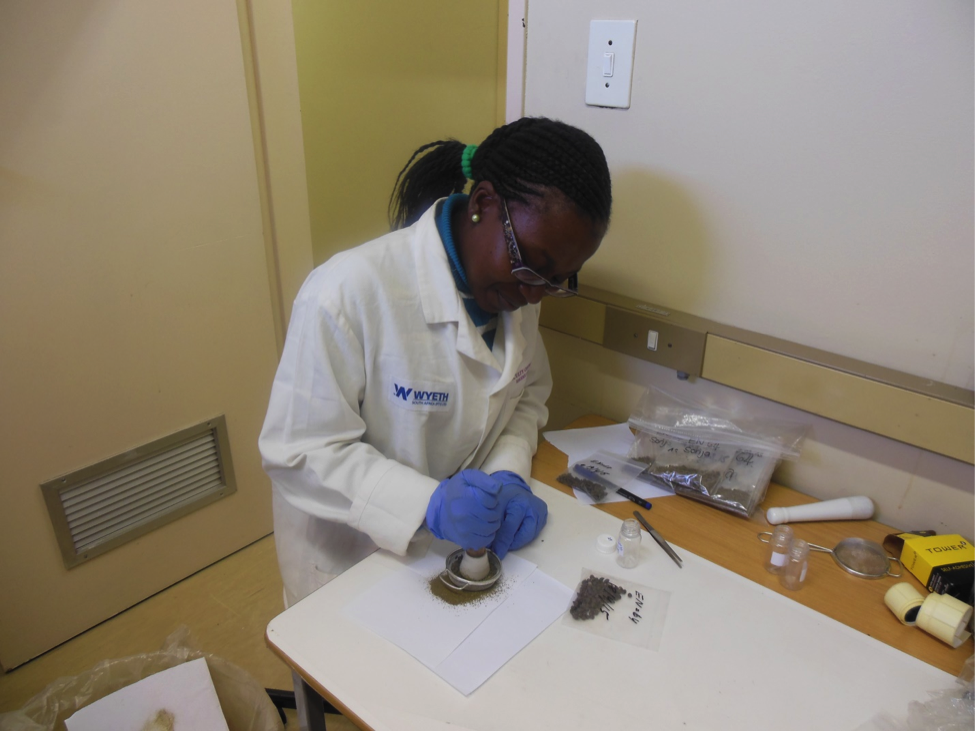
Poop pulverization
The fun begins in the lab when we play around with chemical solutions and extract hormones from the samples. Firstly, you freeze-dry the samples and then crush them before extracting the hormones. So now you have your hormone extract – yippee, but how much of it is in your sample? Caution: plenty of calculations and pipetting involved!
Practice makes perfect
A colleague and I had some pretty embarrassing moments as we quickly reached out for our cell phones when asked to do simple calculations and unit conversions. “You may be PhD students out there but in here, you are elementary level” a staff member joked. It didn’t help that our pipetting skills got worse as the weeks progressed – the harder we focused, the worse we got. “When you focus too hard, you tense up and make more errors. You need to relax and get into a rhythm that works for you” was the advice we got from the experts. We’re tough field biologists – who knew transferring liquids in a controlled environment could be so tricky?!
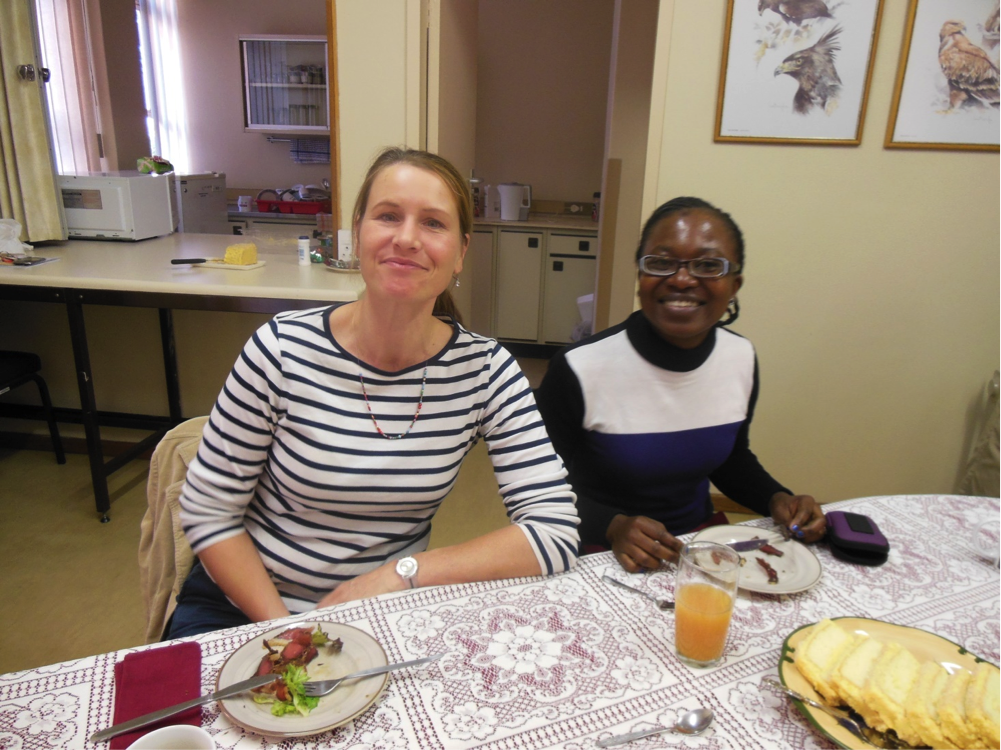
Stephanie, our patient poop tutor
Despite our failures, the exposure and experience we gained were invaluable. It was also comforting to know that it took the professionals several months of trial and error to master their art; we couldn’t possibly get it right in just three weeks. I must admit I have new respect for the challenges of a lab environment – it’s not all as straightforward as I’d thought. I went home in high spirits, looking forward to my next lab visit to perfect my skills. After all, practice makes perfect, or in this case, poo-fect!
Rubbing shoulders with the big guns — the new Dr Amanda Yucca Chulayo
Just the other day a senior colleague and a big sis, Dr Amanda Yucca Chulayo, graduated with her doctoral degree in Agriculture-Animal Science. It was a great achievement and the beginning of a new chapter for her. For me it was inspiring and motivating. The thing is, she is “one of us”- another girl from the small town of Cofimvaba, blossoming for the whole world to witness.
Myself and Amanda, some years ago. I would like to think the conversation was about our work on cattle, getting some tips from the sweetest breed – Boran.
Seeing her make it out strong despite of all the ups and downs I have seen and heard from her about her academic journey made me reflect on my own share of troubles. See, the journey itself may be bitter at times but the fruits to bear at the end are certainly sweeter. I know it’s hard to think about the sugary side of it when you are busy climbing the mountain with its obstacles.
As Greg Child said “Somewhere between the bottom of the climb and the summit, is the answer to the mystery why we climb”
The last picture I took with the Boys just before they were transported.
It sure is a climb…
I am currently in the phase of my studies I would like to refer to as “The beginning of the end.” It has been a long and hectic five months of data collection and everything before and after that. The Boys are gone and I don’t really want to talk about it. They were loved dearly.
In short, we wrapped up all the behavioural observations and physiological sampling. I had to organize all the administrative issues around the slaughter processes. The observations and sampling was followed up during transportation and slaughter. And now, at the “almost” end, I am only left with some lab analyses.
Well, for obvious reasons, a part of me is glad it is all slowly coming to an end. But so far, I’ve learned more than I thought I could, and I think it’s not nearly the end of the learning process for me, even though I am edging closer and closer to that Dr title.
I think I am going to start writing a journal on “lessons of the day” just to make sure no day goes by without a dose of daily development. For instance, I have learnt a lot about myself, other people, different animal species and a long list of skills during this period of my studies: • Selfie 101: I learnt that Yonela (Myself) is a strict, highly organized (Oh Yes I am!!!), straight forward and a professional person, period! She pays attention to details and she doesn’t really allow room for negotiations when it comes to that. Over time she can lose her cool when her patience is being tested. She gets frustrated when things are not going in order. She may be a sensitive person but she is very forgiving and has a big heart. She has learned to talk about herself in the third person 😉 and she might be doing better that she realizes… • Society 101: I have learned that not everyone is as bad as I always perceived (personal experience). There are still good hearts out there, like those that tirelessly devoted their time and energy assisting me with my field work. As a good friend said in Shona “Yu werokamu” which means “we help each other,” and if it wasn’t for them, I don’t think I would have ever practically learned and seen the significance of that concept.
Of course you also have to learn the tough lessons about people. A friend made me realise that people will always talk. Whether you do “good or bad” there will always be those that are simply not satisfied with you. Sometimes you may know the reasons but sometimes you may not. But you can’t live trying to please other people. The lesson there is that you always strive to do the right thing, stick to your path without even trying to please anyone but God… in that way you will be safe. • Animal 101: The time I spent at the farm was my favourite part of this PhD process. I always say that animals are the best creatures. I learned that it’s not just dogs and cats that are interesting, with that ability to amaze and make you smile. All animal species are fascinating and entertaining in their own way (but, sure, I may be biased a little bit…).
The Boys filling up in the afternoon for an evening snack — it’s their favourite time to graze.
For instance, I didn’t know that donkeys were such anti-social creatures. We (with the Boys) were in the same paddock with them the other day and they would make sure to move further away whenever we got closer. But most of all, the animals I have studied all taught me to stay true to myself and always stick to the people that support and understand me. • Time 101: Who would have thought that I (without being pushed) would make decisions to go to the field on weekends – even long ones and holidays? When I joined postgraduate studies I was told that there are no holidays at this level but I would always steal myself some time. I now have learnt the importance of each and every second. Time adds or subtracts towards the goal, depending on how it’s used.
Don’t they say you reap what you sow? I believe that! For every sacrifice there is a reward. One of the greatest examples is in the Bible, that of Jesus on the cross. One just needs to focus on the mission at hand and be disciplined, keeping the ultimate end in mind. What is a couple of holidays and weekends compared to the time of harvest? The ultimate goal…
All in all…
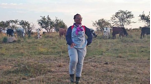
The last day of paddock behaviour observations — my catwalk to the finish line.
One has to take a breath every now and again to reflect. As the Greek philosopher Socrates famously said, “The unexamined life is not worth living,” and that is true about the smaller parts of that life, including the PhD journey. Every journey is a teacher; either you take the lessons positively or negatively. What matters is the destination, which should inform your decisions. Whenever you feel discouraged, find inspiration from wherever you are. It could be from within or from other people or things. Just keep taking those steps towards the finish line.




 SAYAS BLOG