When asking myself the advice I would give to my younger self, a question pops up:
Are we mirroring our circumstances or conduits to taking charge of who we are?
Being a young person in 2023 has some unique challenges and opportunities. If we get down to the nitty-gritty of it, being young regardless of what day and age you’re in has come with its own troubles. For one, since the dawn of humanity, old people tend to get a bit huffy about the activities of young people. Greek philosopher Aristotle summed up his sentiments on the youth as the following:
“Their lives are regulated more by moral feeling than by reasoning — all their mistakes are in the direction of doing things excessively and vehemently. They overdo everything — they love too much, hate too much, and the same with everything else.”
This quote might as well be from this year! At the behest of most people, even though we were all young ourselves at one point if we forget how much we still had to learn about the world, we tend to place the burden of conforming on younger people. When in fact, it is not young people’s responsibility to deal with the current state of things, but to have their solutions orientated towards the future, the problems that we cannot foresee at this moment. From movies, science and beyond there is always a fascination with the concept of time-traveling; what would it be like to share what we already know from the future? What would try to warn our younger selves about? What would we equip them with? I saw a hilarious tweet on my timeline once that said they’d offer a glass of Fanta Orange to a caveman just because they can. For me, I have realised that despite the role of mentors, teachers, parents, guardians, and advisers (although they have tremendous influence), experience is the one thing that teaches you lessons you can never forget. When I think about my own research and the areas of interest I have in my freelance writing, it always tends to gravitate towards things I know my younger self would have wanted to know. So here are two things I do that help me effectively learn from experiences not only as a person but as a postgraduate student.
Two Tips for Reflection
- Journaling.
You can either use prompt questions like the ones below or use freewriting (writing without worrying about grammar or structuring your words) to just get your thoughts on paper. Even though it’s more writing on top of your academic writing, freewriting and journaling allow for a creative way of staying on top of your studies while developing a healthy coping mechanism at the same time.
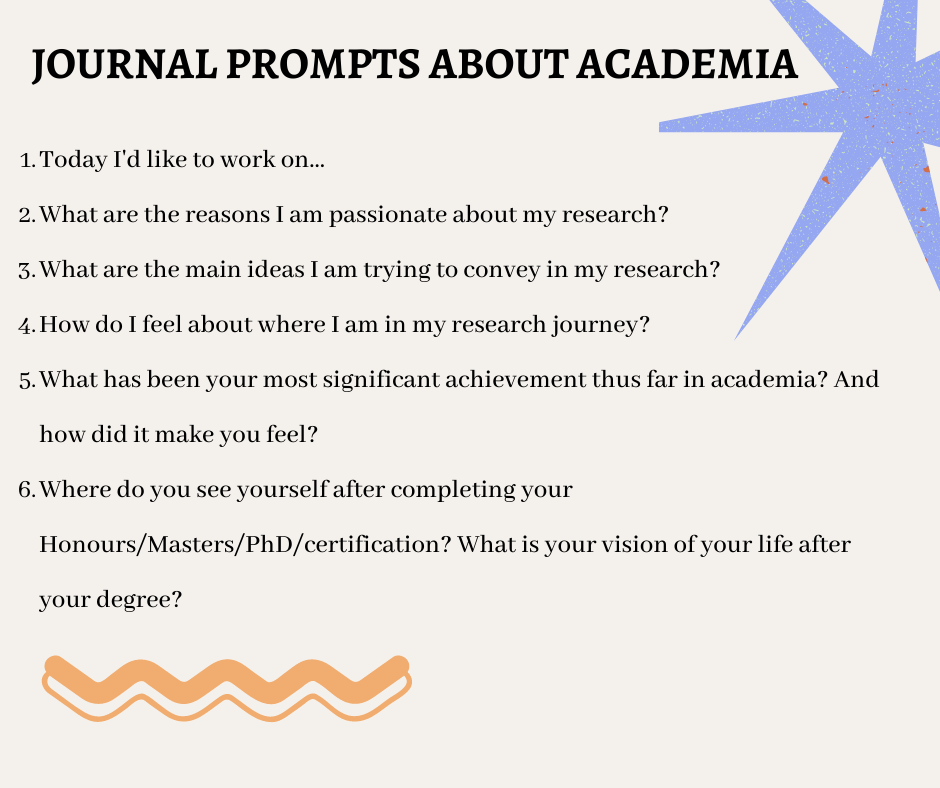
- Follow up consistently.
When you’re in university for the first time, or feel intimidated by the institution, knowing the structures that are there to help you makes a massive difference. If you get a lower mark than expected on an assignment, it does not hurt to follow up with your lecturer and see where you could improve. Not feeling ashamed from previous mistakes and accepting continuous feedback as part of the journey allows you to improve as a student over time. Additionally, asking questions in your tutorials and lectures may feel embarrassing, but you always be better off for having asked than remaining silent. When students can communicate where they are struggling and what they need help with, it counts in your favour and allows you to stand out.
In some ways, the youth already know they are conduits for radically rethinking existing global crises that have reached their breaking point. But the pressure to solve everything at once does not fall solely on one set of shoulders. By incorporating at least one or both practices of reflection mentioned above, we do not have to feel overwhelmed with trying to exceed unrealistic expectations. Rather, we can do our best to be conduits to change by simply just trying to be better than the day before.
 SAYAS BLOG