To describe someone as ‘cold’ implies a lack of feeling, that their behaviour is not in line with what is considered ‘normal’. Therefore, it comes as no surprise that when applied to women, those that do not fit into the happy, compliant tropes are seen as ‘cold’. When women do not live up to traditional notions of womanhood, it disrupts the social order set forward in society. This is the segue into my blog today, where will be unpacking the ice queen trope!
You may have heard of the term ‘ice queen’ before. But if you haven’t, here’s a basic definition:
“A descriptive expression employed to characterise callous women who exhibit minimal or non-existent emotional displays. These individuals present themselves as aloof, displaying limited compassion, tenderness, or affection towards others or anything outside their own self-interest in most circumstances.”
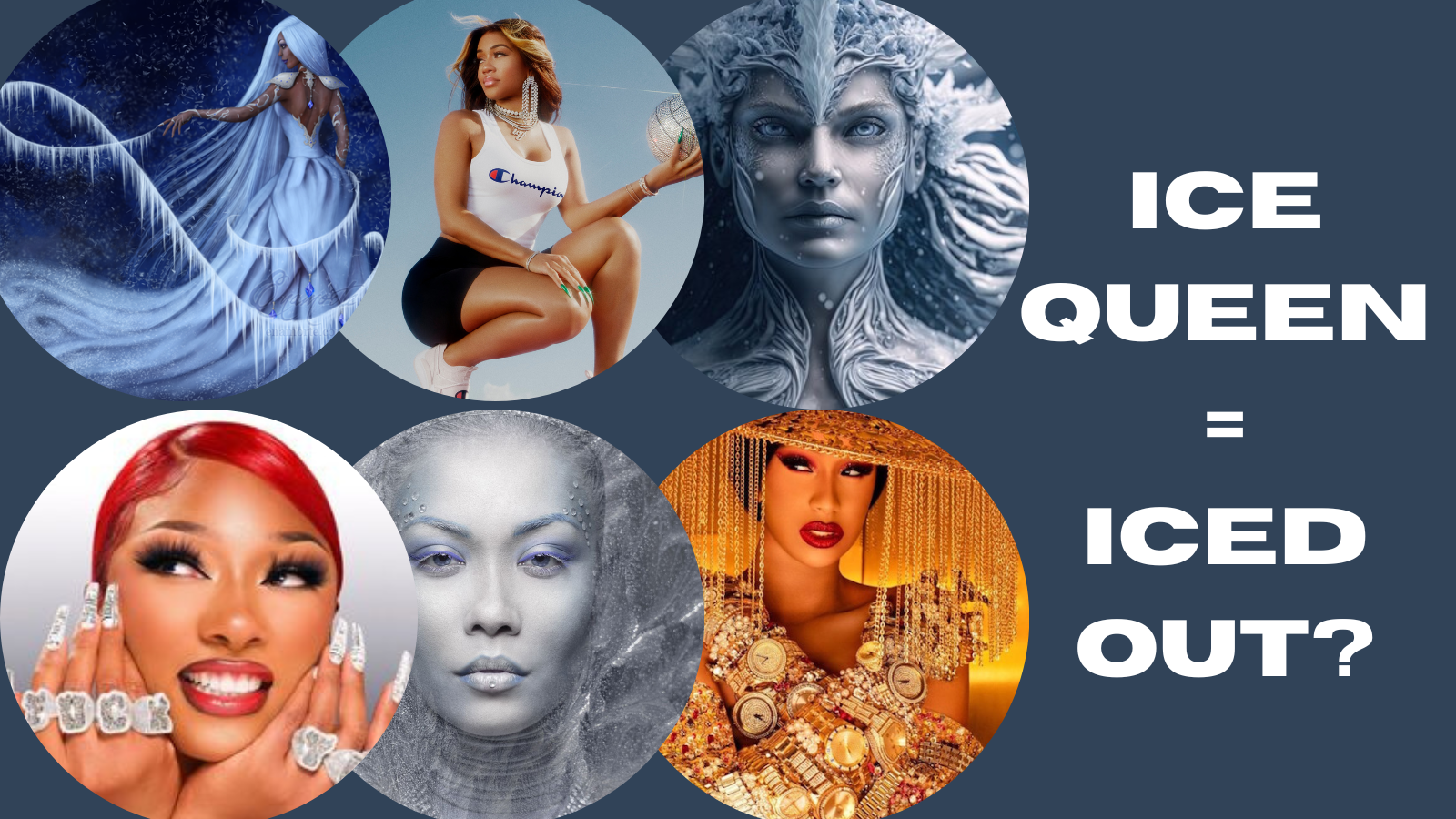
Examples in popular media include Miranda Priestly from The Devil Wears Prada, Jadis the White Witch from The Chronicles of Narnia and Cersei Lannister from Game of Thrones. They often play antagonistic roles, where they are often ridiculed for their inability to show emotions.
In my research, I look at how slay queens function within postfeminist ideology, particularly in relation to black femme experiences. However, in black pop culture discourse, being ‘icy’ or ‘iced out’ has different connotations. For example, hip-hop culture popularised being ‘iced out’, which also implies being covered in jewellery. Therefore, being ‘dripped out’ is a signifier of conscientious consumption and the behaviours associated with it. Attributes associated with being perceived as cold and distant are often assigned to black women who are read as “b*tches”. Yet, the act of self-preservation functions as a means of what Lazar (2009) calls propelled entitlement – where the act of self-making functions as an exclusive space of consumption. To what extent can agency be seen as active resistance beyond being seen as a b*tch? For the most part, ‘ice queens’ in themselves wield powers that comes from said oppressive systems, and not in spite of it. Although their power functions as a necessary representation of transgressive femininity, there are deeper problems with how said power functions to internally regulate the status quo.
And what may that status quo be?
It could be the icy castle they keep themselves locked up in, the turned-away gaze from suffering, the jewellery or luxury items at their disposal or blasé redundancy with which their efforts to change things end up being in vain. Slay queens are an archetype in which being an ‘ice queen’ would function to an end. Stoic sensibilities with no regard for community, and a prioritisation of the self become chillingly clear when considering the pursuit of capitalist endeavours. In the end, one thing is for certain – heavy is the head that wears the crown.
 SAYAS BLOG