South Africa and unmet basic human rights 25 years later: Food safety and why it matters?

What is food safety and how is it linked to food security?

A quick scan of the DSI-NRF Centre of Excellence in Food Security will demonstrate how inextricably food safety and food security are linked. Food safety is firmly located within the universally recognized and adopted definition of food security by the Food and Health Organization of the United Nations (FAO). The FAO in its’ fact sheet defines a country to be food secure when all people at all times have economic access to sufficient, safe and nutritious food, which underscores that without food safety there can’t be effective food security. 

What is the link between food safety and human rights? 

In the devastating aftermath of World War II, the United Nations General Assembly (UNGA) meeting in Paris adopted resolution 217 (A) in 1948 culminating in the Universal Declaration of Human Rights. This declaration was intended to be universally applicable and to supersede all domestic law to create a base of equitable rights and standards worldwide. Article 25 (1) of the declaration provides the legal basis affording all humans the right to access sufficient food. 

Domestically in South Africa, the post-Apartheid constitution (27) (1) (b) (Constitution of the Republic of South Africa, 1996) endowed all who live in the country with an inalienable political right to “sufficient food and water”, though problematically it doesn’t articulate what amount is sufficient or which tier of government is responsible to fulfil the mandate. Brittany Kesselman linked this political right to food justice within the socioeconomic context of South Africa. Her study noted that South Africa still has a long road to travel to meet this constitutional and universal right imperative. To this end, in 2013, a report by the Legal Resources Centre noted that the state of unmet human rights in South Africa was a ‘state of unconstitutional affairs’. 

What are the implications of poor or inadequate food safety governance? 

Food security is more than agriculture. It’s about access, safety, nutrition and government (as well as nongovernmental) policies that promote a healthy wellbeing for all. For Maslow (1948), food was a base physiological need, which he argued if not met, the pyramid that culminated in life self-actualization could not be achieved.

Graphic courtesy of Saul McLeod, Simply Psychology, Maslow’s Hierarchy of Needs, 2018

In 2015, the UNGA adopted resolution 70/1, which established 17 Sustainable Development Goals (SDGs). Two years later the FAO (2018) issued a warning that an estimated 821 million people worldwide remained under-nourished and food insecure. According to the FAO, SDG Two – Zero Hunger – was not on track to eradicate hunger by 2030. South Africa will be hard pressed to achieve both SDGs and the localized National Development Plan by 2030 without securing sufficient, safe and nutritious food. Walthouse (2014) stated that chronic hunger and malnutrition affect all aspects of education and life because food is the fuel the human body requires to undertake all activities. Effects include: increased vulnerability to lifestyle diseases; lowered immunity leading to chronic illness; behavioural problems and environmentally induced mental illnesses. In the South African context, it is particularly devastating, since it places an enormous burden on the public education and health sectors as well as initiatives to overcome the nearly 30% unemployment rate and the shameful recognition as the most inequitable country in the world. This again points to the need to prioritize food safety and nutrition within broader food security and socioeconomic imperatives and yet in his 2019 State of the Nation address, President Ramaphosa gave food security a passing reference. A week later, in the budget speech, it was not mentioned at all. 

What advice can we give to the South African government that access to safe and nutritious food is an overdue and yet critical right? 

The advice is equally simple. First recognize food safety as a core pillar of food security. Second acknowledge that food security is a human and political right long overdue to be a lived right. Third understand that where not achieved, it breaks the pyramid of socioeconomic success including achieving the SDGs and NDP by 2030. Fourth progress will not occur overnight but it can start in 2020 with being prioritized in the mid-term budget. Fifth bring together experts in prevention, identification, containment, governance and law to in earnest draft new legislation with accompanying regulations and a clear work study that maps the actors, their responsibilities, linkages and points to leverage incorporating the numbers and skills required with well-defined response plan and chain of command in both ongoing day to day processes and times of crisis.

In conclusion, what is the link with Human Rights Day?

Human Rights Day is commemorated on the 21st March in South Africa, this being its 25th anniversary. It is a reminder of the inhumanities people of colour suffered, specifically acknowledging the 69 killed and 180 people injured by the police in what is now known as the Sharpeville massacre, given it was a peaceful protest against racial discrimination. This year as we observe Human Rights Day, let us be an active citizenry that not only remembers the injustices of the past but focuses on the inequalities of the present. Let us invite a struggling student for a meal, drop off food supplies (whatever your budget allows) at a children’s or homeless shelter, take fresh fruit to work and give it as care packages to those who earn the least or even start planting the seeds for a vegetable garden at your work or in your community to create sustained assistance. It’s a small start, but the biggest successes can come from the few individuals willing to make a difference. On the 21st March look up at the stars that shine from the victims of Sharpeville and let them see that we keep their memory alive, not through words, but deeds that work towards fulfilling all human rights for all our people. 
Be the change you want to see in the world

Is the research we are producing in South Africa locally contextualized, relevant and addressing societal needs?

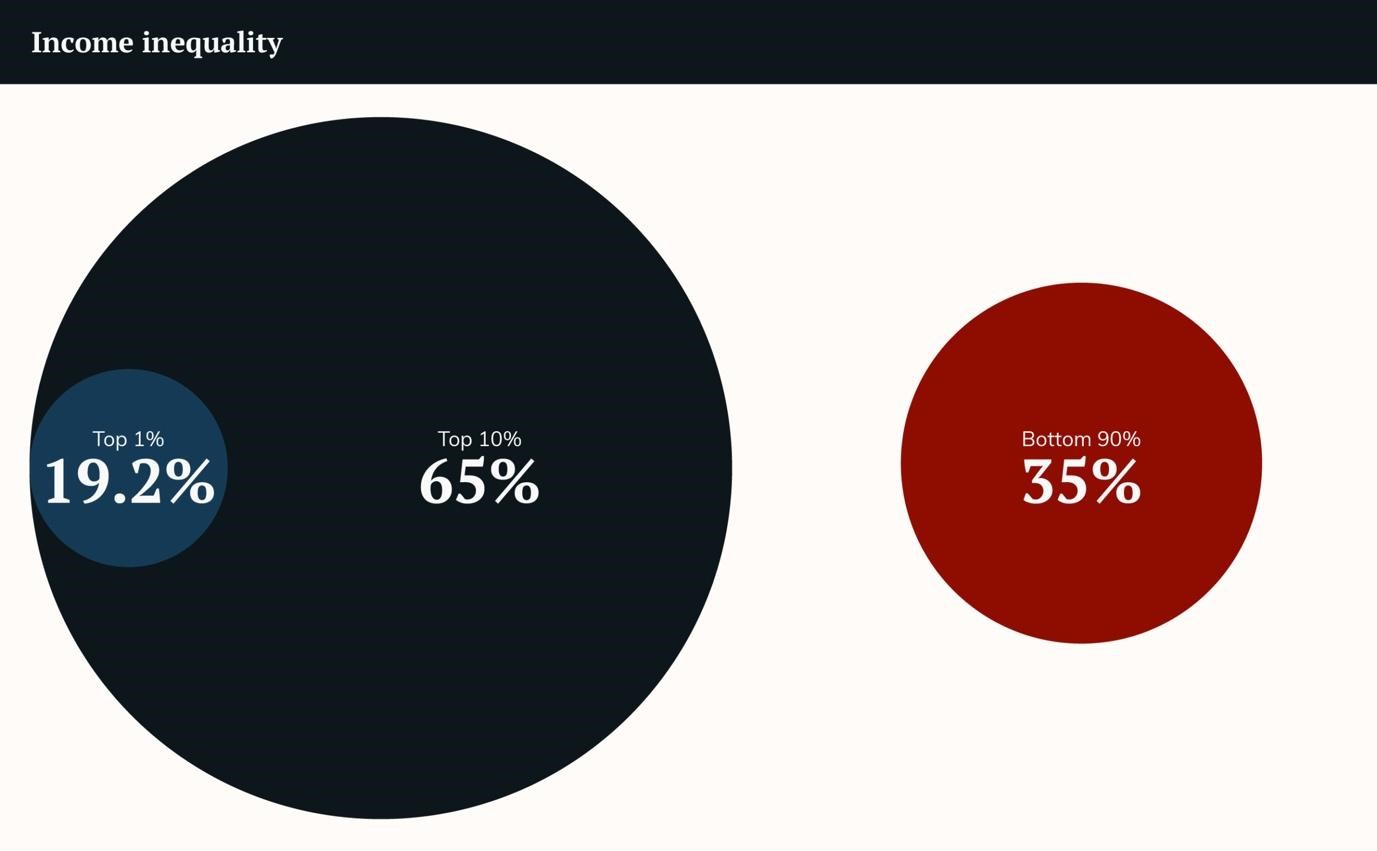
In the 2000s social justice became a buzz word, hence in 2009, the United Nations declared 20 February annually for the international observance of World Day of Social Justice. The 2020 theme being ‘If you want peace and development, work for social justice’. In South Africa, there can be no discussion on the topic without adding the word economic social justice. A Statistics South Africa (2019) report acknowledged that usually, inequality is more between nations, for example, Spain is more equitable than Venezuela. Yet, South Africa holds the dubious placing of being the country where the most inequality exists internally as opposed to another state. As per the graphic below, only 1% of the richest have almost 20% of the wealth, only 10% earn 65% of South Africa’s income, creating a bleak picture for the remaining 90% of South Africans and underscoring why the triple challenge of poverty, inequality and unemployment cannot in 2020 remain political rhetoric, but 26 years into democracy, requires urgent turnaround. 

Income Inequality by Ryan Honeyball, World Inequality Database, 2019

In South Africa, wealth and access to resources isn’t the only dividing factor. The legacy of colonialism and Apartheid have created a countrywide spatial plan that research by the Socio-Economic Rights Institute of South Africa (2016) explained seriously undermined the ‘other’ to access opportunities such as employment, transport, education and basic services thereby entrenching the divide between the have and have-nots. 

There are many wise words spoken on being the change in our world, a few noted below: 

Using these quotes and understanding the indisputable levels of inequality in South Africa, the question must arise as to how do those of us engaged in research and academia ensure that our work, irrespective the field of study, is locally contextualized, relevant and addresses our societal needs, the most pressing here being socioeconomic justice.

In 2019 Prof Tawana Kupe became the first black vice-chancellor and principal of the University of Pretoria. Off the bat, he stated that under his tenure the university would focus on research that is relevant to society. In his own words, “Our research must address the issues that are most pressing to the communities in our country and on our continent. These include achieving food security and addressing climate change, unemployment and poverty, inequality and violence.”

From this vision, Future Africa emerged with the University of Pretoria as its base. The institute aims to mobilise African scientists across faculties and the continent to collaborate using multidisciplinary and technology-based research to develop innovative and locally contextualized responses to Africa’s most pressing societal challenges, in other words, research that matters. 

This issue of study/research relevance often rears itself in the almost annual debate on access to institutions of higher learning, notably from the agenda-setting momentum created by the 2015 #FeesMustFall movement. Of late, there are even questions over whether we produce too many PhDs and if their research makes them employable or over-qualified for the market outside of academia? Without being specific, I recently participated in a postgraduate conference and was surprised by the number of research topics that I couldn’t connect the dots to tangible societal outputs. I wondered then, as I still do now if the new Vice Chancellor’s vision is for the university to produce socially required and relevant research, who is allowing and sponsoring the topics, not in line with this very specific objective? I personally research on improving public policy and implementation on food safety within the broader political rights of food security, to prevent another foodborne disease such as the 2017/18 listeriosis outbreak that caused many deaths, too many unnecessarily so. What are you researching? What are you supervising? What studies are you funding and approving? 

Within this context as we continue and up the ante on the discourse over the decolonisation of education in South Africa, I argue that it would be socially irresponsible to place not only the number of graduates and PhDs we are producing and the costs thereof on the agenda, without a deeper understanding of the skills, research and studies that South Africa requires to actualize the vision espoused at the dawn of our democracy in 1994 of socioeconomic justice for all. As we move towards the National Development Plan and Sustainable Development Goals, both earmarked to be met by 2030, this question of the co-production of societal need-based research and skills needs to be even more urgently answered. Government and civil society must work with academia to establish the short, medium and long-term research goals required to fulfil constitutional and international obligations such as meeting universal human rights as well as achieving the strategy that best serves our national interests.

Using this framework, institutions of higher learning, need to create enabling environments to produce the skills and research that our society requires to develop and compete on the global stage. Ultimately, this means that you (and I) need to ask ourselves the tough question – ‘does my study contribute to an aspect of acknowledged societal need or is it simply because I am interested in the topic and have the time/money to pursue it?’ There may come a time in South Africa where we will have the luxury of studying at our whim and passion, but surely that time is not now in 2020 when we have 29% unemployment, an average of 17 million social grants paid annually for basic survival, a quarter of the population living below the food poverty line and a reminder again that only 10% of the population earn 65% of all income generated.

Laurie Buchanan wrote ‘whatever you are not changing, you are choosing’.

Read that again academics.