The journey continues, the progress and the lessons…

Several things have changed since the last vlog I uploaded in January. For the most part, I have been released from the ‘bench’ doing desktop work and moved more into the practical side of my degree. This has come as a huge relief seeing that it has been many months since I first registered as a PhD student. Maybe let us start from the beginning. As the year commenced, I made my way to Pietermaritzburg to start my contact face-to-face, the component of my PhD instead of the online work we all did during COVID-19. I first arrived and started by re-writing a proposal that I had written and re-submitted it. As months went by I wrote a review paper for submission for publication, which I must say was interesting. This is because I have written a review paper for my master’s work, but as I mentioned in a previous blog, one of the pressures of being a PhD student is wanting to become the best and produce quality work. I struggled for the first few months of the year. One of the struggles was finding the novelty in the study, which was mentally draining since my work is a continuation of the work I did in my master’s. I read a lot of articles on how to find the novelty in your work, and one interesting blog on this topic interpreted this well.  The blog articulates how one can look at the merit of their study even before they publish it in any journal or write a proposal for their PhD. My supervisor’s strategy is to write a proposal and review it for six months, to familiarize oneself with literature to an extent that when you go to the lab, it should be just that. Being in a new place means new rules, and this made me uneasy. I was coming to the lab to see other students who registered with me or even after I start their lab work. But I had to trust my supervisor and the process. In the six months, I did submit my review paper and started going to the lab officially end of August. It has not been bliss; it has been even more difficult than I thought.

Unfortunately, in as much as I had thought I had prior experience of working with the materials (porphyrins), I am also learning a lot through my many failed experiments and giving a scientific explanation as to why they did not work. Growth is never easy, as most people would attest, but it also comes with the satisfaction of more knowledge and discipline. At this point of my PhD, I am working through the synthesis of my starting materials, porphyrins to be specific, and obtaining the purest product from NMR which is one of an organic chemist’s biggest nightmares. Am I satisfied with my pace? Not really, but I am moving and I am patient with it all.

I have also over a couple of months learned about the power of collaboration, which I also spoke about in one of my past blogs. I have come to admit and be open to help, to help, and being helped by my colleagues in terms of everything. I have come to terms with the fact that we don’t often know it all and speaking out loud may help the work to progress. Moreover, to that, it may even ease your mental health. Speaking of which, I am continuing with therapy and it has been amazing, not only do I have new perspectives to look at life but I am slowly becoming an independent thinker and a critical one too. Many people often ask the question of what I wake up to do each morning and my answer is always simple: I wake up and go to the lab. I know it requires more work than it sounds, but the video attached to the blog displays a typical day in my life, which will explain further what I mean.

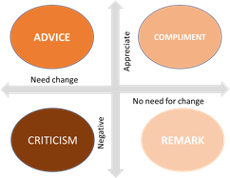
How sensitive are you to feedback and criticism?

How many of us appreciate being criticized for our work?

One of the best lessons I have learned through my postgraduate years is to be able to absorb criticism and feedback and appreciate the positive side of it. I did not always have this appreciation; it did not start out as a positive adventure at all. I started out as a naïve and afraid student and received detailed feedback thinking that maybe people did not like me or that they wanted to prove that I am not intelligent.

Fortunately, I had supervisors during my Masters who honed my presentation skills and removed my ‘stage fright’ by allowing me to attend many conferences and symposiums. During this time, I learned a lot about myself and how feedback improved my academic skills. I remember the first time we had our presentation in the Polymer/Organic group, one of our senior postgraduate students was presenting and the supervisors were very critical, and I thought to myself ‘I hope when my turn comes, I do not cry’.  As weeks went by, I realized that the supervisors were hard on all of us, not just on one person, and that is when I realized that it is to train us and not belittle us. Today, when I give a presentation and I am not criticized or asked the hard questions, I know that people did not comprehend what I said, or it was not interesting enough for them to think critically about it.

One of the most discouraging things is to receive negative feedback for a paper that you are trying to publish. Most of us in academia have experienced this. Before the submission, there is a lot of pressure from yourself or from your supervisors and peers. Then unfortunately you often get negative feedback from the reviewers. How does one even overcome that? The first rejections may be a large blow, but the reality is there might be several rejections before the article is accepted for publication.

I had a conversation with one of my friends earlier this year, whose paper had been rejected three times and from these conversations, I learned a few things.

  • The rejections normally come with comments which help one to write or present better.
  • Their rejection is not a reflection of who you are or the type of person you are, it is purely commentary on a piece of written work
  • Dust yourself up, cry if you have to, and do it all over again. Send it to another journal, and put your work out.
  • The more you get rejected the better you get at writing and improving your work.
  • You learn and read from the comments articulated in each section.

This also happens when we are doing writing outside of the scientific space. A few months ago, I submitted a blog to our editor Jen. I had read articles on what I had written and thought I had done very well. Just a few days after submission I received feedback from her. I was on my way to heat food in the microwave when I heard a beep on my phone, I scanned the message and I panicked. The 30 seconds I heated the food, thoughts flooded my mind, ‘does she not like me, does she think I’m a bad writer, she doesn’t find me worthy does she?’ I then sat myself down and calmed myself to look at the piece critically. I felt disappointed in myself for thinking in my moment of panic that she hated me because, with the reviews she gave, she also advised, she showed me the way and I am thankful for that. And with the corrected piece I could see my improvement. One of the messages she gave was, ‘The best way to start writing on scientific topics is to work from your area of expertise.’ I will take that forever because when I did write my next piece, it came out of passion and was easier to write.

We just need to learn to stop over-personalizing the critiques and find what is good in them. I am not saying I am immune to being criticized, but I appreciate being assisted and being told if I am wrong or redirected to the right path. Maybe our rationality is thwarted by our emotions. When we hear criticism, our instinct is to dismiss it. Then, we put up a defense and sometimes even get irritated. Although this is understandable, it works against us. Everything that benefits us should be embraced, rationally speaking.

‘He who can’t take constructive criticism is not ready to grow’- Royalelradin