Mama Charlotte Maxeke: My Superhero

Why was I not taught about her in school?

In line with the commemoration of women’s month, I have chosen to celebrate my superhero mama Charlotte Maxeke. I believe that her story should be documented in science textbooks and even on the biggest theatre stages in South Africa. Hers is a story of resilience and triumph against all odds, a story that resonates with many women in science.

Charlotte Makgomo Manye was born in Polokwane and moved to Fort Beaufort in the Eastern Cape. She attended at the missionary school where her intellectual abilities led her to be a student tutor. When her family moved to Kimberly, she chose to follow her music passion and joined the African Jubilee Choir which toured the world. A failed tour led them to be stranded on the streets of New York, that was when an ex missionary teacher reached out to her and offered her a scholarship at Wilberforce University in Cleveland. This led to her being the first Black woman in SA to graduate with a university degree.

During her academic years, she paved the way for many other South African students to join her at the university. She was also a passionate political activist, upon her return to the country she co-founded Bantu Women’s Leagues which fought against the oppressive apartheid laws.In summary, she was a multifaceted individual who was brilliant in every sphere she set her foot in. Mama Maxeke has often been honoured as the ‘Mother of Black Freedom in South Africa’, an ANC nursery school in Tanzania, and the Johannesburg General Hospital were named after her.

What stands out for me is her versatile nature and her ability to not allow education to box her. The science field is very demanding and most often than not, consumes one’s life. The rigidness of the academic career sometimes scares people away. My undergraduate mentor had advised that I solely focus on my studies until I secure an academic position (that is after PhD and two postdocs!), even suggesting that I relocate to the universities residents to avoid family ‘distractions’. I’ve never blamed him for having this view because this has been the narrative for decades. I think young female scientists need to be exposed to the stories of Mama Maxeke, to be told that one can carve their own path and still be brilliant in their academic career.

Science is only but a career, it cannot define a person’s life. I always advise younger students in our research group to never forget to spare time for their hobbies. A career alone can never bring absolute fulfilment in a person’s life. Hence, I always advocate for people who choose a path that deviates from the norm; if for you starting a family is your source of fulfilment, then, by all means, go ahead, it will require extra effort, but it is doable. If taking a break and focusing on activities that will reignite your passion, let it be so. If advocating for equality and justice is your forte, then speak your truth even if your voice shakes, start movements and clubs at your university. Most importantly, when you find a passion greater than science or academia, pursue it, quitting academia should not be viewed as failure instead it should be seen as bravery. This is the narrative that we should be telling every young scientist.

Researching this piece gave me so much joy; I kept on thinking, I wish I had come across her name in my science or history books in high school? It would have done wonders for my confidence and belief in self. My discovery of mama Maxeke’s stories has also made me realise that a mentor or role model is not necessarily a person you have physical access to, they don’t even have to be present in your lifetime. Just reading a biography could be enough to guide one to their destiny. Through this history lesson, I have a newfound hope, a re-ignition of passion and resilience to see my dreams to reality. I hope that every woman, especially in the field of science, finds that superhero, a lighthouse to run to whenever fear and doubt overcomes them.

Mysteries of the Universe

How much of our universe do we know?

Public science engagements have been the fuel that drives my love for astronomy. Whenever I have astronomy-related public engagements these are some of the questions I often get: Is there life out there? What is the fate of our universe? How was the universe formed? In this blog, I am to tackle these questions and give a brief overview of the universe as we know it.

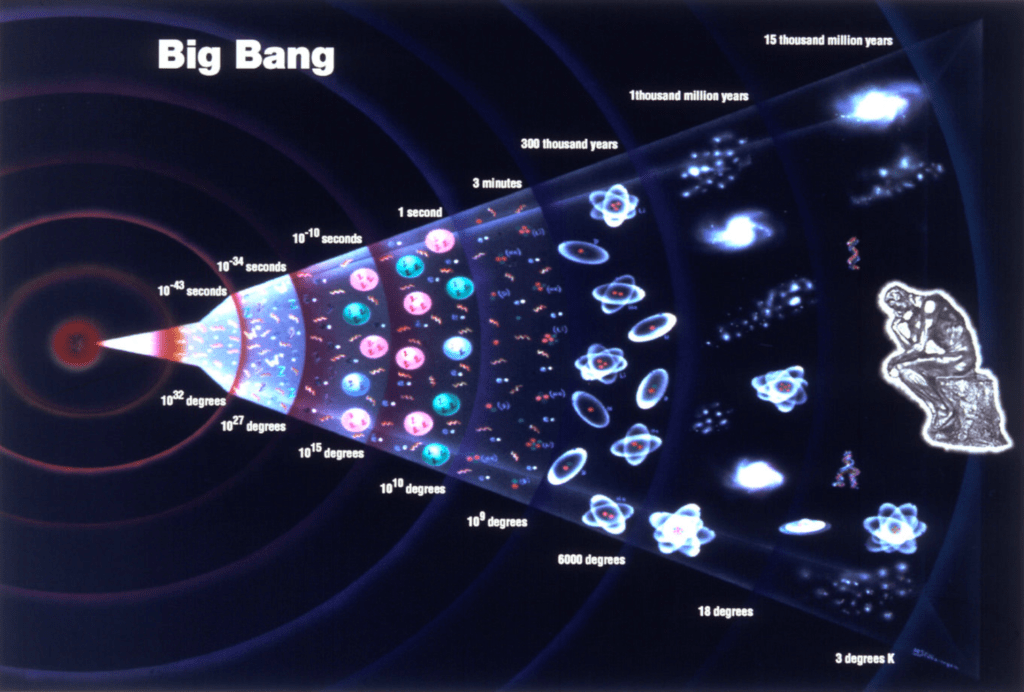
The longest presiding theory of how the universe formed is The Big Bang Theory (no Sheldon is not part of it); According to this theory, 13.8 billion years ago the universe was just a single point (singularity) an explosion occurred (‘big bang’) and the universe started expanding. This period of rapid expansion (inflation) lasted for a short moment, as the expansion slowed down the temperature decreased to a point where basic building blocks of particles started forming (nucleosynthesis). This epoch was followed by a phase where the universe was a dense plasma (Cosmic Microwave Background) the remnants of this plasma are still visible today and can be observed using radio telescopes (e.g. ACT; PLANCK). As the universe continued expanding clumps of matter were pulled by gravity and stars were birthed. As more matter accreted larger structures started forming; first galaxies, then clusters of galaxies and these structure formations evolved to the universe we have today.

Source: phys.org

The Lambda Cold Dark Matter (LCDM) model is the mathematical representation of the Big Bang theory. Lambda (Λ) is the cosmological constant which was used by Einstein to compute his theory of general relativity; it is related to dark energy (which could be understood as a force that pulls things apart, causing the universe to expand). Cold dark matter is deferent to the normal matter (baryonic) as it does not emit light (‘photons’) but its existence is proved through its gravitational effects. According to this model, the universe is constituted of 68% dark energy, 27% dark matter and 5% ‘normal’ matter. So, all the stars you see at night and the billions of galaxies that have been observed only make up 5% of the universe! Using the LCDM model we can also predict the fate of our universe; currently, cosmologists believe that our universe is ‘flat’, hence, it will continue expanding forever and eventually the universe will be a cold frozen place. No need to worry though, it won’t happen any time soon (soon being billion years scale).

Although the Big Bang theory and the LCDM model explain the bulk of the observable universe, it has been adapted to further explain the physical phenomenon that we observe today (e.g. The Oscillating Universe Theory).

The curious mind never rests! So now that we have a clearer idea of the origins of the universe more questions pop up. One of the prominent questions is: Are we alone in the universe? I believe not, but of course, we have to back our beliefs with scientific evidence. There are two main approaches to answering this question; searching for earth-like planets and awaiting signals from aliens.

Kepler, a NASA space telescope is on a mission to locate planets that are in the habitable zone which could sustain life. To date, Kepler has detected 4164 exoplanets and recently it was reported that the most earth-like planet was discovered by the Kepler mission. This exoplanet orbits a star similar to our sun, it’s 1.06 times bigger and receives 75% of the sunlight that Earth receives from the sun. As exciting as it may sound, this planet is 300 light-years away from us; this means that if we were able to travel at the speed of light, it would take us 300 years to reach this planet. So please take care of our planet, we have no alternative home!

The SETI Institute, on the other hand, aims to use radio telescopes to ‘listen’ to extraterrestrial intelligent life. Their strategy is to search for narrow-band radio transmissions that come from outside our solar system, these transmissions would indicate extraterrestrial technological advancement and signal the possibility of intelligent life outside our solar system. A SETI Institute researcher once presented at a conference I was attending, a student asked: ‘So if we do eventually find aliens, what’s the plan?’. The presenter didn’t quite answer the question, my only hope is that they would be kinder than humans.

Astronomy is an exciting field because it is continuously evolving. With the majority of the Square Kilometre Array (SKA) being hosted by South Africa, there has never been a better time for young students to hop on the astronomy bandwagon. The SKA project will require expertise from various fields such as; Engineering, Artisan, Computer Science etc. The beauty of astronomy is that it doesn’t box one to a particular set of skills but instead exposes one to various fields.

The ultimate ‘cherry on top’ is that although many questions have been answered, many more are yet to be asked. Sometimes it takes decades to answer one question (e.g. the existence of gravitational waves) and at times the discovery of one phenomenon raises a thousand more questions (e.g. Fast Radio Bursts). So if you, like me, are always on a quest for problems to solve; then astronomy will be equally fascinating for you.