Over the rainbow

Knee-high in snow and clinging to memories of how the African sun warmed my skin and heart, I reflect on my journey from the rainbow nation to francophone Canada. This is a tale like no other; it is neither “rags to riches” nor “tragedy”, but a simple quest for scientific excellence mixed with adventures of a travelling South African.

My undergraduate studies were rather uneventful. If I’m honest, like many of my peers, it was time of experimentation and self-discovery. Throughout my journey of self-discovery it became clearer to me what I wanted to do for a job and career. Similar to many of my peers, I was being thrust forward into an Honours degree, and when I was a young 20-something graduate, it dawned on me that the dream I had had was not bold enough.

Post-graduate realisation[1] hit me hard and I did what most graduates would not dream of – I took a gap year. It was during this self-imposed ‘sabbatical’ that my yearning for traveling the globe grew even out of hand. I remember thinking, “ a BSc in Ecology and Zoology is not what it used to be…” Of course, I wasn’t sure what a BSc in Ecology and Zoology should be, but I knew it wasn’t It anymore. Nonetheless, I was determined to make something of myself and pursue my dream of becoming a world-renowned ecologist.

Then I got the chance to visit a friend who was teaching English in Seoul, South Korea, and the food, the people, the culture all conspired to draw me to east Asia. But I wasn’t just playing around, there is a certain bravado and courage that we South African posses that sets us apart from the rest of the world. And, I had the guts to approach the leading professor in soil ecology at Korea’s top university (Seoul National University). I boasted about South Africa’s gorgeous, unique Fynbos. Immediately, I was the new shiny toy in the box. The beauty and complexity of the Fynbos is the envy of many ecologists, and I managed to start a project with one foot in Asia and one still in Africa. That was just the beginning of my postgraduate adventures, almost all of it built on the back of people skills and love of Fynbos. Who knew ecologists had to be such good psychologists?

Graduation at Seoul National University

Upon graduation, I began to pack up my life once more and prepare to move to Canada where I would start my Ph.D. I must admit, I love everything about travelling: the airport, new cultures to explore, and — most important — the chance to make new friends. But, I have always said, “I came here with 1 bag and will leave here with 1 bag”. In principle, this rule would serve you well, but when you have lived in a new country for 2 years, you will accumulate stuff. Packing up your life into a 20kg bag arouses feelings of catharsis and reinforces the feeling of excitement about moving to a new place (out with the old, in with the new kinda feeling). Little did I know that moving to a ‘western’ country after being immersed in Asian culture would come with its own challenges, but that’s a story for another blog.


[1] The realisation that a bachelors degree will not suffice and guarantee the kind of job or future that you were day dreaming about during first-year.
If I were a plant pathogen, I would want to be a Phytophthora species

In the spirit of Saint Patrick’s Day (March 17), lets talk about Ireland. In many Christian denominations of Ireland, Saint Patrick’s Day is considered a feast day. However, ironically, I want to talk about the Irish potato famine.

Phytophthora infestans St Pattys


Why are there so many Irish communities around the world? Because nearly 25% of Ireland emigrated as a result of mass starvation caused by a plant disease in the mid 1800s. This disease, known as potato late blight, is caused by Phytophthora infestans.


Phytophthora is a Greek word that translates as ‘plant destroyer’ (phyto=plant, phthora=destroyer).


Phytophthora is the name of a genus or group of microorganisms that destroy plants by causing disease. Microorganisms that cause disease are referred to as plant pathogens. Pathogens in this group are responsible for many plant diseases around the world. For example, as mentioned previously, P. infestans already changed the history of the world, and is still causing issues today, even in South African potato and tomato fields.

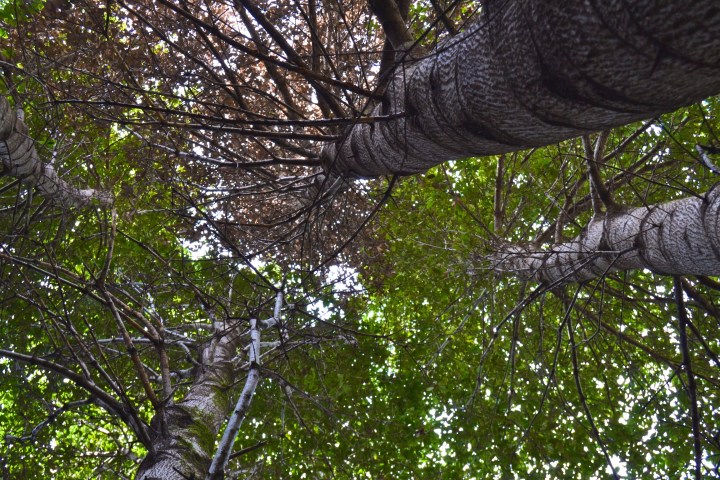
Phytophthora species are causing many epidemics around the world. Five of the top 12 tree diseases in the UK are caused by Phytophthora species. One of these is also responsible for Sudden Oak Death in the United States—my first introduction to Phytophthora. Click here to see pictures from a recent excursion into Sudden Oak Death infected lands.

DSC_6061

Other notable Phytophthora diseases include Jarrah dieback in Australia, Kauri dieback in New Zealand, and Daño foliar de pino in South America.

Actually, the pathogen (Phytophthora ramorum) that causes Sudden Oak Death in the USA also causes ramorum blight in the UK, where it kills Japanese larch, an important timber species. One pathogen causing two major diseases on two continents! Both countries have spent millions trying to control the disease—not even counting the costs from damages, ecological impacts and increased regulations—yet South Africa may not even be looking out for it.

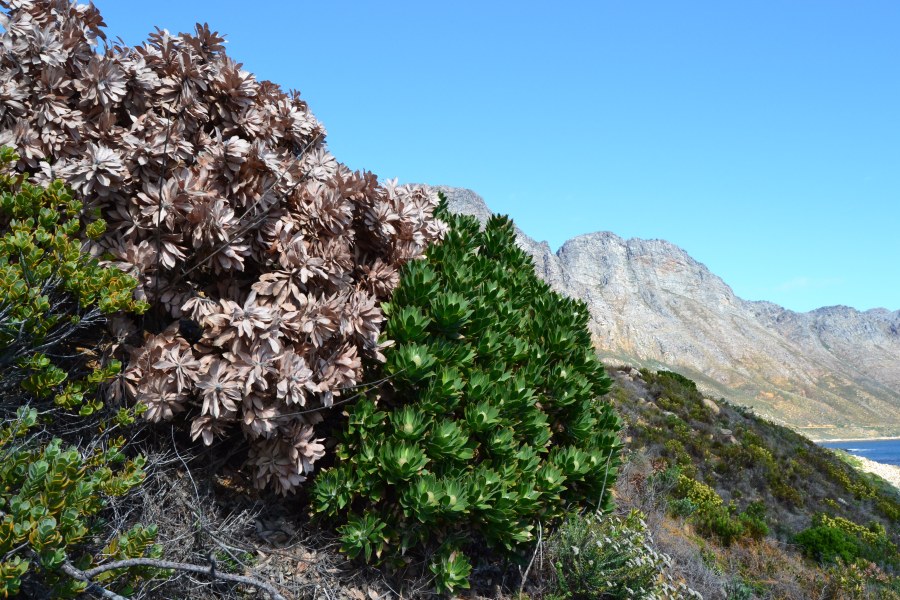
One species that is affecting South Africa is Phytophthora cinnamomi. This species, dubbed as the ‘biological bulldozer‘ in Australia, threatens South African proteas, orchards, vineyards and plantations. Even though this species is known to infect more than 2500 native species in Australia, we have a poor understanding of its impacts in fynbos here of South Africa.  This is one of the justifications for Cape Citizen Science, a research project focused on Phytophthora species in the Western Cape Province. You can contribute to this research and to the understanding of the impacts of Phytophthora cinnamomi by participating as a citizen scientist.

CankerSilverTree

Unfortunately, because Phytophthora species are microscopic, they are frequently (accidentally) spread around the world. I like to think we are getting better at stopping this from happening, but the reality is that more plant pathogens are introduced every year—frequently from the global trade of live plants, but also potentially from the soles of our hiking boots.

brasier

I can’t say what would happen if Phytophthora ramorum was introduced to South Africa (investigating this would be a cool research project), but after seeing the impacts of Sudden Oak Death first hand, I can say it is definitely worth watching out for. Hopefully if it is introduced, we can detected it early and eradicate it before it spreads too far to control, like it has in the UK and the USA. This is another justification for Cape Citizen Science. By reporting dying plants, you may be the first to detect a exotic and invasive Phytophthora species. The fynbos biome is immaculate because of the high amount of endemism—having many plant species that only exist here in South Africa.  Because of its incredible biodiversity, it is important to protect, and we can protect this biome by being on the look out for dying plants, reporting the ones that you come across. Cape Citizen Science is a platform for making these reports.

Even more scary than Phytophthora ramorum are the species that havn’t been discovered by science. It is estimated that between 200-500 species of Phytophthora are yet to be discovered. For example, oak trees started dying throughout California before Phytophthora ramorum was actually described and the origin of this pathogen still remains unknown. There are many Phytophthora species out there, some that may even be native to the fynbos biome. Identifying these species is another objective of Cape Citizen Science. By participating, you could be the first to collect a completely new species of Phytophthora.