Building a mastermind group

As I draw to the close of my PhD program, my thoughts have increasingly focused on my career. While I am fortunate enough to be doing my PhD within an active research unit, I’m still feeling unprepared for my next career step. I feel that I’m expected to go take what offers and opportunities ever come my way. But all the signs point further contraction of viable positions in academia. As romantic as being a struggling academic may seem to some people, I would like to NOT have to spend the rest of my adult life perpetually pursuing various nominal research grants to keep food in my fridge.

In the human and social sciences, there are a plethora of research groups based within think tanks and universities; although a lot of work is done is silos. So how do I prepare for my own eventual career? Getting academic information is easy; but career information? There is a lot of fumbling around in the dark on your own.

In my field of study, there are four traditional research career paths you can follow: academia; non-governmental think tanks and advocacy groups; working for the government; and doing political risk analysis for the corporate sector. Each path has different output expectations and ways to prepare; a doctorate is only necessary for academia. I have come across a few successful social scientists who move comfortably between the different sectors. All these people have the same thing in common — networks.

Networks are important, but I believe that they can be more useful if they are  structured and intentional like “mastermind groups.”

Napoleon Hill conceptualized the idea of a mastermind group in his 1937 book “Think and Grow Rich.” He describes this group as being a union of people who will support each other in pursuing their goals. My goals are to produce high quality output and have money in my bank account. Both goals need support and some mentorship from those who have gone ahead.

I’m toying with the idea of creating a mastermind group for several reasons- the main one being my daughter, now in first grade. I witnessed her move to new heights in her academic abilities by working in groups. Her reading in particular has benefited from paired and group reading exercises. I figured if that achieved with a child why won’t it work for professors?

In her Forbes article, 7 Reasons to Join a Mastermind Group, Stephanie Burns breaks down the pros of group mentorship:

  1. “Exclusivity”
  2. More potential advisors
  3. More potential collaborators
  4. Access to a wider network
  5. The opportunity to learn new things
  6. The potential for “cross promotion”
  7. Stretching the limits of your thinking.

To me, it looks like the possibilities are endless. And you are not a lonely academic struggling for funds on your own.

But I have no idea how to start such a mastermind group. Do I go online? Do I just fall in with a larger research agenda? Do I go “sell” myself at conference?

If anyone has any experience of using a mastermind group to succeed in their post-PhD careers please share in the comment section below. Is it worthwhile to join a group or it is better to be a lone cowboy? How did you do it?
If I were a plant pathogen, I would want to be a Phytophthora species

In the spirit of Saint Patrick’s Day (March 17), lets talk about Ireland. In many Christian denominations of Ireland, Saint Patrick’s Day is considered a feast day. However, ironically, I want to talk about the Irish potato famine.

Phytophthora infestans St Pattys


Why are there so many Irish communities around the world? Because nearly 25% of Ireland emigrated as a result of mass starvation caused by a plant disease in the mid 1800s. This disease, known as potato late blight, is caused by Phytophthora infestans.


Phytophthora is a Greek word that translates as ‘plant destroyer’ (phyto=plant, phthora=destroyer).


Phytophthora is the name of a genus or group of microorganisms that destroy plants by causing disease. Microorganisms that cause disease are referred to as plant pathogens. Pathogens in this group are responsible for many plant diseases around the world. For example, as mentioned previously, P. infestans already changed the history of the world, and is still causing issues today, even in South African potato and tomato fields.

Phytophthora species are causing many epidemics around the world. Five of the top 12 tree diseases in the UK are caused by Phytophthora species. One of these is also responsible for Sudden Oak Death in the United States—my first introduction to Phytophthora. Click here to see pictures from a recent excursion into Sudden Oak Death infected lands.

DSC_6061

Other notable Phytophthora diseases include Jarrah dieback in Australia, Kauri dieback in New Zealand, and Daño foliar de pino in South America.

Actually, the pathogen (Phytophthora ramorum) that causes Sudden Oak Death in the USA also causes ramorum blight in the UK, where it kills Japanese larch, an important timber species. One pathogen causing two major diseases on two continents! Both countries have spent millions trying to control the disease—not even counting the costs from damages, ecological impacts and increased regulations—yet South Africa may not even be looking out for it.

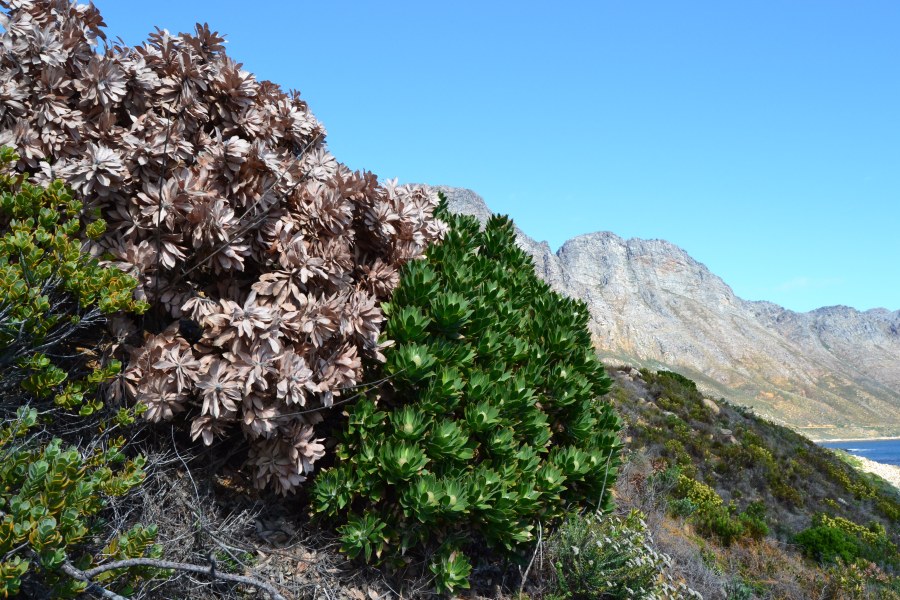
One species that is affecting South Africa is Phytophthora cinnamomi. This species, dubbed as the ‘biological bulldozer‘ in Australia, threatens South African proteas, orchards, vineyards and plantations. Even though this species is known to infect more than 2500 native species in Australia, we have a poor understanding of its impacts in fynbos here of South Africa.  This is one of the justifications for Cape Citizen Science, a research project focused on Phytophthora species in the Western Cape Province. You can contribute to this research and to the understanding of the impacts of Phytophthora cinnamomi by participating as a citizen scientist.

CankerSilverTree

Unfortunately, because Phytophthora species are microscopic, they are frequently (accidentally) spread around the world. I like to think we are getting better at stopping this from happening, but the reality is that more plant pathogens are introduced every year—frequently from the global trade of live plants, but also potentially from the soles of our hiking boots.

brasier

I can’t say what would happen if Phytophthora ramorum was introduced to South Africa (investigating this would be a cool research project), but after seeing the impacts of Sudden Oak Death first hand, I can say it is definitely worth watching out for. Hopefully if it is introduced, we can detected it early and eradicate it before it spreads too far to control, like it has in the UK and the USA. This is another justification for Cape Citizen Science. By reporting dying plants, you may be the first to detect a exotic and invasive Phytophthora species. The fynbos biome is immaculate because of the high amount of endemism—having many plant species that only exist here in South Africa.  Because of its incredible biodiversity, it is important to protect, and we can protect this biome by being on the look out for dying plants, reporting the ones that you come across. Cape Citizen Science is a platform for making these reports.

Even more scary than Phytophthora ramorum are the species that havn’t been discovered by science. It is estimated that between 200-500 species of Phytophthora are yet to be discovered. For example, oak trees started dying throughout California before Phytophthora ramorum was actually described and the origin of this pathogen still remains unknown. There are many Phytophthora species out there, some that may even be native to the fynbos biome. Identifying these species is another objective of Cape Citizen Science. By participating, you could be the first to collect a completely new species of Phytophthora.