Poo-rification

By Keafon Jumbam

I recently attended three weeks of intensive laboratory training on fecal hormone assays – okay, let’s be honest: poop analysis. If you’re thinking- eeuw, you are not alone. Before embarking on this PhD degree, collecting poop didn’t cross my mind. I mean, who thinks about poop, right? Except, hard-core dieters and maybe crazy scientists? And now I’m one of them, patiently waiting on batties to – em – crap so I can scoop it up, much to the surprise of the batties themselves. But guess what, there’s plenty of power in poo. Let me explain.

Lab work involves eating, naturally.

When stressed, an animal releases stress hormones into its system, which is commonly measured through blood extraction. But therein lies the catch: the very act of capturing and drawing blood from an animal is not only cumbersome but could contribute to further stress. And that’s not all; licensed personnel and strict ethical requirements are needed to carry out such operations. Thanks to recent advances in science, you can avoid all the above logistics by simply collecting poop. All you need do is wait for the animal to do its business – which in my case is pretty easy, since we spend time with them daily collecting behavioural data. The best part is that it’s a non-invasive and simple method of collecting scientific data without interrupting the animal’s normal activities. Once collected, it is crucial to freeze the samples immediately to prevent hormonal degradation.
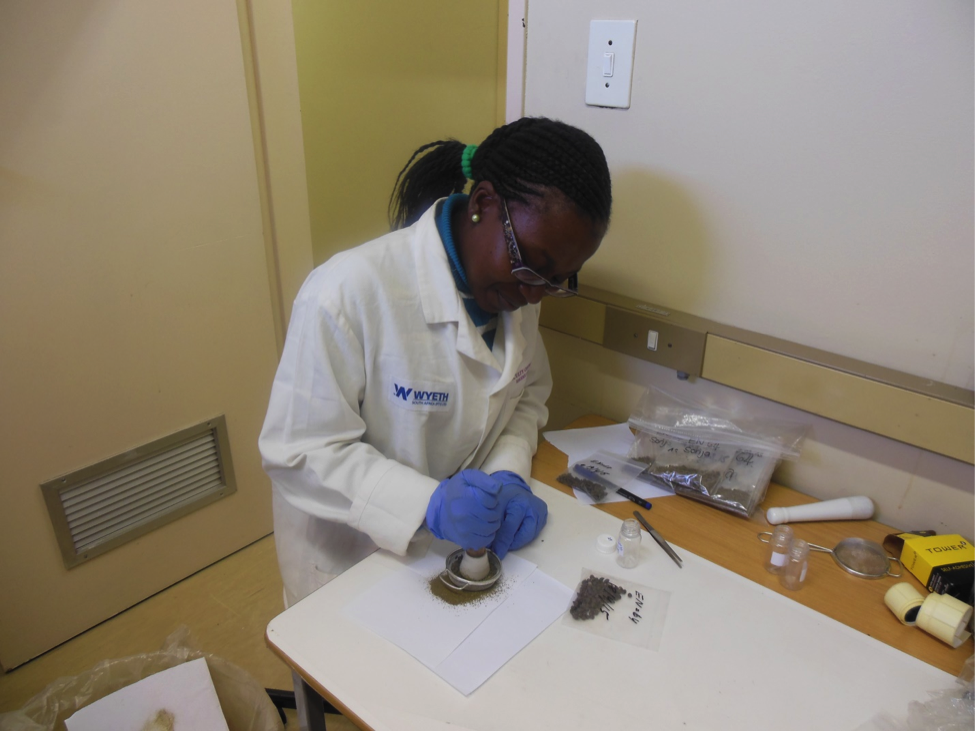
Poop pulverization
Poop pulverization

The fun begins in the lab when we play around with chemical solutions and extract hormones from the samples. Firstly, you freeze-dry the samples and then crush them before extracting the hormones. So now you have your hormone extract – yippee, but how much of it is in your sample? Caution: plenty of calculations and pipetting involved!

Practice makes perfect

A colleague and I had some pretty embarrassing moments as we quickly reached out for our cell phones when asked to do simple calculations and unit conversions. “You may be PhD students out there but in here, you are elementary level” a staff member joked. It didn’t help that our pipetting skills got worse as the weeks progressed – the harder we focused, the worse we got. “When you focus too hard, you tense up and make more errors. You need to relax and get into a rhythm that works for you” was the advice we got from the experts. We’re tough field biologists – who knew transferring liquids in a controlled environment could be so tricky?!

Stephanie, our patient poop tutor

Despite our failures, the exposure and experience we gained were invaluable. It was also comforting to know that it took the professionals several months of trial and error to master their art; we couldn’t possibly get it right in just three weeks. I must admit I have new respect for the challenges of a lab environment – it’s not all as straightforward as I’d thought. I went home in high spirits, looking forward to my next lab visit to perfect my skills. After all, practice makes perfect, or in this case, poo-fect!

Biofilms for dummies: what you need to know

By Ruenda Loots

Microorganisms are everywhere. Run your tongue over your teeth: that fuzzy feeling after a meal is a microbial community laying down foundations on your enamel. These communities, or biofilms, can form on almost any surface, especially if the surface is slightly wetted. That includes river rocks, the inside of your tap and even the lining of your gut. “Don’t panic!” (I had to remind myself during the first part of my research). For the most part microorganisms perform vital functions in ecosystems and our own bodies. We use biofilms in bioremediation plants to treat wastewater and as micro-factories to produce certain biochemicals.

Print
Print

Seeing as we share so much of our planet and intimate internal spaces with microbes it is worthwhile getting to know these critters better. Now, keep in mind that when I started my research, I didn’t know anything about microorganisms. I opted to study psychology instead of microbiology during my undergraduate degree (#ifonlyIknewthenwhatIknownow). So this post is a very basic summary of what I had to learn in the first year of my PhD.

Biofilm basics

We first discovered microorganisms in their single free-floating, planktonic forms in the 1600s. As microscopic techniques advanced over the years our understanding of this parallel miniscule universe has greatly improved. We now know that almost all microbes have the ability to attach to a surface and that most of them prefer living together in these anchored communities. Biofilms are made up of three parts: the organisms themselves, the slime they produce and the water molecules trapped between the slime particles.

Benefits of being in a biofilm

Biofilms have been called microbial cities: microorganisms build three-dimensional slime structures, live in close quarters and share resources. There is strength in numbers: together they create a favourable environment, this self-created matrix structure anchors them to a surface while protecting them from predators and harmful chemicals. Like our cities space, waste and food can create tension between neighbours but it means the community stays fighting-fit.

In laboratories we tend to study single-species biofilms – they’re easier to cultivate and it’s easier to draw conclusions when you are studying a homogeneous population. The truth is that single-species biofilms hardly ever occur in the natural world. Biofilm communities can include many different kinds of bacteria and eukaryotic species (organisms that have cell centres and membrane-enclosed organelles). Scientists are only starting to grasp the incredible complex communication methods that develop within these communities, something like chemical Twitter. The ability to communicate is vital to the survival of these microbial communities and often underpins their ability to dodge our anti-microbial treatments.

The good

Most of us have an instinctive “ewh gross” response to the thought of microorganisms and use anti-microbial chemicals on the daily. Read the contents of your dishwashing liquid, toothpaste or shampoo: almost all personal care products contain chemicals like triclosan, triclocarban or alcohols. Most of these are completely unnecessary: we need certain bacteria on our skin to maintain a healthy pH and our digestive system is dependent on microflora in our gut. Watch Rob Knight explain the wonder that is your personal microbial community:

https://www.youtube.com/watch?v=i-icXZ2tMRM

The bad

Of course some microbes can make us sick. Pseudomonas aeruginosa is one of the most common culprits, an opportunistic pathogen that is a leading cause in many hospital-acquired infections and chronic lung infections. P. aeruginosa has inherent abilities to resist many antibiotics, especially in biofilm-form, and is one of the ‘superbugs’ we struggle to combat with drugs. Because microorganisms are constantly exposed to sub-lethal levels of anti-microbial chemicals (the soaps etc. we flush down our drains) they have the opportunity to develop coping mechanisms. When resistance mechanisms develop in a microbe it can pass these lessons along to others in the biofilm community. That’s why biofilms in food processing plants, water distribution systems and hospitals pose such a threat to us; they can harbour drug-resistant terrorists.

Another reason to “go green”: I’m in the process of replacing all my household cleaning and skincare products to natural alternatives. You can find great locally-produced ones online; I recommend Earthsap and Bee Natural!

The slimy

The self-produced ‘slime’ matrix that houses the community is the key to its ability to adapt, evolve and survive. Microorganisms form this matrix by secreting a wide range of macromolecules (proteins, carbohydrates, lipids and even DNA): each biochemical component has its own function and provides additional functions in combination with other components. In a natural environment there are infinite combinations of microbes that may form a biofilm community, these communities can produce infinite combinations of biochemical matrixes, the composition of the community and matrix changes over time and adapts to changes in the environment, creating infinitely complicated systems.

Infinitely complicated systems… sounds like a create topic for a PhD, right?