A week off…

So, I have to do analysis for pesticides and heavy metal analysis in water for my Master’s project. Unfortunately, we don’t have the equipment for that in our lab: I had to find a lab that does. Luckily enough, I discovered the University of Johannesburg’s Department

Picture1
The Analytical & Environmental Chemistry laboratory, UJ.

of Applied Chemistry, which heads up the Analytical & Environmental Chemistry Research laboratory. This research visit was truly a week off from my very typical and everyday academic life.

On my first day I joined the members of the research group in their preparatory presentations for an upcoming seminar. I always thought my research was isolated from the realm of the truth and practicality. Listening and watching different students at Masters and PhD level presenting their research on wastewater was really an awakening for me. If I wasn’t certain before, now I am sure that ecotox could become my life! A couple of studies caught my attention but I don’t want to give too much away…


One student was synthesizing a nano-composite to adsorb lead in the acid mine drainage. Another studied the desalination of seawater using a specific nano-composite, while somebody else tried to work out how to remove personal care products from water. As the students were presenting this work, in my mind I kept asking myself why I didn’t know about this stuff sooner. On the other hand, I was grateful I experienced this at this level of my study when I am still trying to find what I want to do for my next postgraduate program.

The second day was lab work. From learning to dilute concentrations and processes of preparing analysis reagents, it was a roller-coaster. I felt like a sponge – a rather happy sponge! The processes weren’t necessarily easy but it all just clicked. In a chemistry lab of all places! Without any further elaboration, let me just say I felt at home.

Picture2
Me, doing pesticide extraction using the solid-phase extraction method

One thing that stood out for me, apart from working with the amazing Prof Nomngongo and her students, was that the experience was the culmination of what I’ve been saying from the start. Through collaboration, interdisciplinarity and open-mindedness in research… this is how we build our research capacity in Africa. This is how we make science fun.
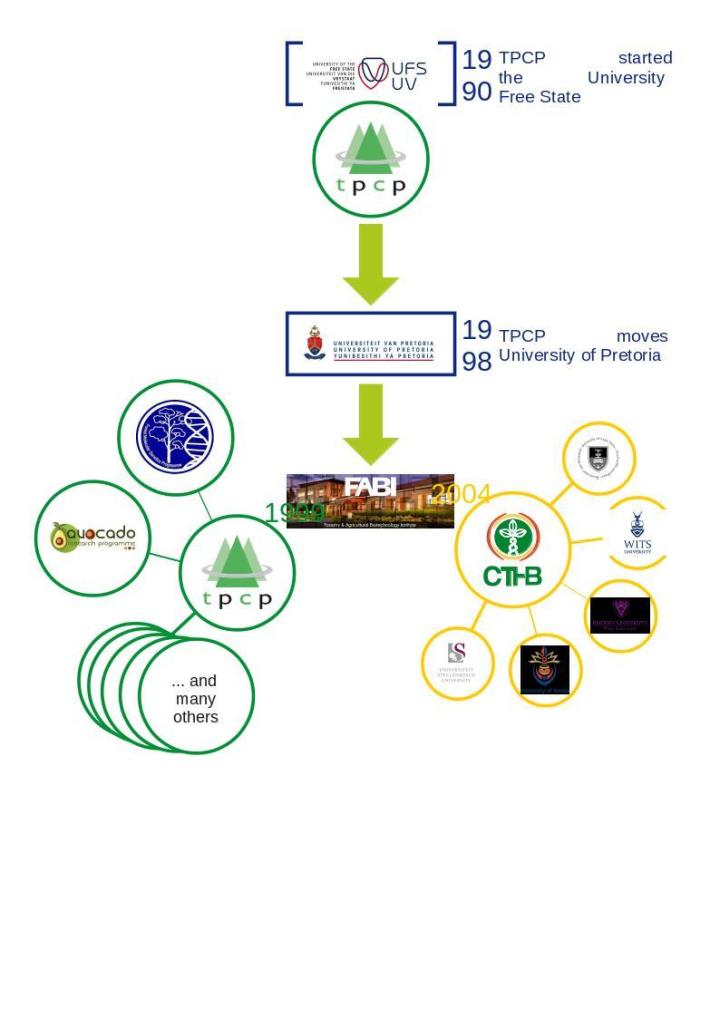
What is at the Centre of Excellence?

In 2004, the Department of Science and Technology (DST) with the National Research Foundation (NRF) established the first seven Centres of Excellence (CoE). These Centres, based on the successful CoE models implemented overseas, were adopted to build on existing capacity and resources but also aimed to bring researchers together to collaborate across disciplines and institutions to drive science excellence.

I joined the Forestry and Agricultural Biotechnology Institute (FABI)–the host institution of the Centre of Excellence in Tree Health Biotechnology (CTHB)–in 2008 when I started my Honours degree. At the beginning on my Honours, I didn’t quite understand what the Centre of Excellence was or why it even existed. How “excellent” was this programme? Was there a need for tree health research in South Africa? I was really only concerned about doing well and learning as much as I could so that I would be a better candidate for a Master’s. But my eyes have opened up since then.

Between my classes and research project, I was encouraged to get more involved in the CoE’s activities by volunteering to be a mentor for the undergraduate mentorship programme, working in the Diagnostic Clinic (which services both the CTHB and TPCP), attending workshops run by Dr Marin Coetzee, who conducts some of his research in the CoE, and so on. The CTHB–true to the purpose of the Centres–made more room for excellence; more postgraduates could complete their studies through FABI, more essential equipment could be bought, research could include other sectors and not threaten industry-specific funding, opportunities through workshops and collaboration started to grow, leveraging funding and excellence became more important, etc. The CTHB – a virtual centre run through FABI – became a critical part of FABI and because of that, the CTHB absorbed some of its excellence, built on it and delivered its own excellence.

449rw-ho35g
The TPCP began at the University of the Free State before moving to the University of Pretoria, where it became the founding programme for FABI. The TPCP helped start a number of other research programmes that are run out of FABI.  The CTHB started at FABI in 2004 and has linked a number of institutions to FABI and the University of Pretoria. 

I experienced how research can truly grow and have international reach. As the CoE’s research net widened, we started to identify more and more problems of concern to plant health in South Africa—many of them brought on by climate change and globalization. Because of the limited capacity in the country, back in 2004 to deal with pest and diseases that were arriving from other parts of the world, the importance of national and international collaborations and knowledge exchange became a priority. These close connections–that are still being built and expanded today–have led to growth in South Africa’s capacity; not just around FABI but at all the institutions linked to the CTHB. In 14 years, the CoE has produced 786 publications, 125 students, and really changed the ways in which we understand diseases of our native plants.

As a student associated with a CoE, I have had better opportunities for funding, wonderful teaching, mentorship, collaboration, and international exposure. Like those that have come before me, I plan to contribute to the science excellence in the country and grow more excellent people. No matter what happens to these Centres in future, as funding continues to dry up, we need to remember to keep excellence at the centre of anything we do—for us, for our country and for the world.