“We need a break, it’s both of us (but more you than me)”

I have said this line to my degree. More than a few times.

I began my undergraduate degree at WITS University in 2011. I was a fresh-faced 18-year-old and had the world at my feet. Then reality set in and I went from being a top achiever at the high school to failing my chemistry block test (“Oh sweet girl, if you only knew you would fail a few more before finally passing”). That was the first time I thought, “We need a break”. BSc undergrad and I had hit a rough patch; my first-year spark was dying down; our love was dwindling. At the time though, as a first generation WITSIE, I knew I could not call it quits. My family had made sacrifices to get me here and BSc and I simply had to work it out. Eventually, we did, a few more downs, a couple of failures (so many) and at the end of it, my marks afforded me the opportunity to join an Honours program.

depression

Honours was a tough time, the course was intense and it was the first time I had undertaken a ‘big’ research project; a bit overwhelming. I had a great support system in some of my classmates but I was still exhausted, I would leave for campus at 5:45 AM, endure a 30-45 minute bus drive to campus, work all day, get home at 6pm and start working again before an uneasy sleep only to repeat the cycle again the following day. I was tired, I knew it, my family knew it but I justified it by saying “everyone goes through this”. I found myself getting sick frequently as stress was taking a toll on my health. I was unravelling but I did it with a smile on my face because I thought that this was normal and that I had to be grateful. ‘I’m fine’ is the default answer, when it is usually the waving red flag.

After I completed my honours I made an important decision and said: “I think we need a break”. I took time off before my MSc and went to work for a few months. Although there were many contributors to my decision, ultimately I needed time off from my academic path. My supervisors and I stayed in contact and a few months later, they offered me a place in an MSc project that I was really excited about, so I returned in August of 2016. I felt so energised that I decided I wanted to plan my project so that I could complete it within a year. My approach was different, I didn’t work from sunrise until sunset, instead I set myself weekly goals and how much time it took to reach them was completely up to me. I kept my supervisors updated frequently (maybe too frequently) and they were supportive of my approach. One of my advisors had recently relocated back home to America early on in my degree and we had a 10 hour time difference but still managed to make it work (and work well) this showed in my project. It was big, it was stressful but it was flowing, relatively smoothly because I had to supervisors who didn’t see me as a work mule but instead allowed me to thrive through gentle guidance and many open conversations. I am grateful for that support, it is rare in academia.


Academia and I broke up once more as I took a year off between my MSc and my PhD (which I am beginning this year) and I went to work full time. To some, it may seem that I am not as dedicated to my degree as students who choose to go through it all in one go but I am dedicated, to myself first and foremost. It is another mechanism to protect myself from breaking; a stop to gain momentum again and make important decisions such as the choice of institution, supervisors and potential projects.

The Guardian published a great article early in 2018 on mental health in universities, more specifically the experience of PhD students. This article also highlighted the ripple effect, stressed senior academics (who are often the product of a flawed system themselves) can often take frustrations out on their students leading to anxiety-ridden postgrads. There are numerous other examples of articles highlighting mental health problems in academia, from different perspectives, in different fields and the fact that it is so common means we can’t write it off as the experience of a few ‘weak’ students because it is clearly a systemic and deeply engrained problem.

A recent study that looked at over 3,500 PhD students in Belgium found that one in two PhD students experienced psychological distress during their PhD. The South African Depression and Anxiety Group (SADAG) released statistics in October stating that 1 in 4 university students had been diagnosed with depression. Although I think that number is higher because, within our communities, we are taught that mental health and mental illness is not legitimate, it is embarrassing and we do not discuss it. We are yet to examine these statistics in a South African context especially amongst first generation people of colour entering the university space. This demographic often has compounding stresses as we try to survive in a world our families often do not understand but one that we want to thrive in because we feel we owe it to the people we love to do so. I was fortunate to have my family and support system within reach, not many first-generation students do and this is possibly one of the toughest journeys to walk alone.

Academics can’t afford to adopt a ‘well I went through this and I survived’ or a ‘they just were not cut out for it’ mentality when students are dropping out of programs, leaving the field or most saddening of all, taking their own lives. That approach leads to a ‘lost generation’, students who had the potential to succeed but were derailed by unsupportive and negative mentors. As an academic community, we need to address the stigma surrounding mental health problems and work toward an environment and a people that are conscious of their mental wellbeing.
It’s that wonderful time of the year…

It is Christmas time. Someone said a PhD student is not hard to shop for – just give them “time, patience, and steady job prospects”. And I like that very much. It is also that time of the year where we write Christmas cards to our family, friends and colleagues. “Merry Christmas and a Happy New Year…” In lieu of my last blog here, I am writing a thank you note / Christmas letter to everyone remotely related to my PhD experience, including my future self.

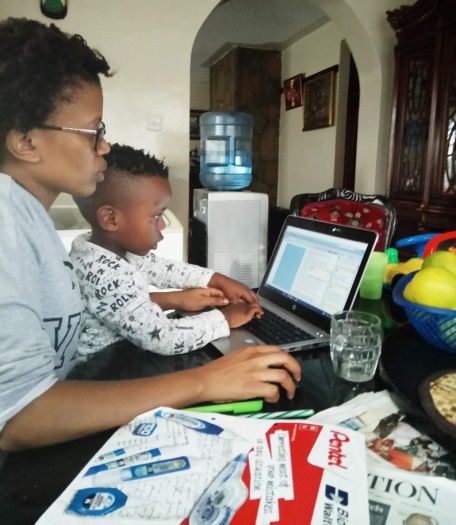
My family

pic 1
With my youngest, he better not ask for co-authorship.

Merry Christmas and a Happy New Year. Your presence this year has reminded me that this journey is not mine alone, that other people have a stake in it too. I have loved simplifying my thesis in one sentence, literally explaining to a 6 year-old. Studying when you are around has trained me to be disciplined with my time; to focus on doing the meaningful stuff and taking the necessary breaks. Taking a break in the day to cook for us, and taking walks with you has been all the therapy I need. You are an important part of my identity, one that threatened to be consumed wholly by “being a PhD student”.


My parents/brothers and sisters (including in-laws)

Thank you for caring about my self-determination, and asking often, “how is school going?”, and “when do you finish?” Yes, as PhD students we often don’t like hearing these questions; so thank you for understanding and accepting the short and simple answers of  “it’s going” and “soon”. I really appreciate your big dreams for me; how you think I will be able to get any job I want as soon as I complete this degree. I am often too tired to discuss the reality, and I would rather have the positive affirmations.  You are a big part of my positive outlook on my future.

My supervisors

Thank you for being reliable, consistent and open about your own challenges and the nature of academia. Seeing you balance your own work and still giving me prompt and constructive feedback on my project is inspiring to me. I hardly have enough time for the PhD — and it is all I do — so I don’t know how you do all you do. I feel confident that in the next year we can build on the positive and productive momentum we have created, in order for me to submit my thesis. I will need what you have always provided in the past, which is your experience, wisdom and knowledge. I have learned so much from you in the past three years that I will keep with me when I become a supervisor too.

My PhD friends and colleagues

Thank you for the laughs and the inside jokes this year. Thank you for all the personal stories you have told me, and for making me comfortable to tell mine. It has been amazing the number of stories we could tell each other over lunch or dinner between intense, isolated work sessions. I was happy to be your springboard for ideas as you were mine. Thanks for nodding enthusiastically as I ranted on and on about my project and giving advice the best way you could J Thank you for reciprocally taking my advice as well, even going as far as calling it “great advice, thank you!” 🙂 We make each other feel and do better.

pic 2
Some PhD colleagues and friends at a recent writing retreat.


My school and funding body

Thank you for the financial and other support that enables me to dedicate all my time to this PhD. We complain it is not enough but even CEOs of Fortune 500 companies think they deserve more. And those guys get a lot; they categorically don’t deserve more. I digress. Thank you for always lending an ear to the ways in which students could feel more supported, and creating tools to ensure that it happens. Thank you for the analysis software licences, the retreats, the conferences, the journal clubs, the support for extra coursework you name it. Thank you for showing your compassion to starving students on campus – through the food donation drive and feeding schemes for the general student body. And thank you for being full of approachable world-class professors/lecturers who are willing to talk to you about your project and listen to your challenges even though they are not even your supervisors. Thank you to the university at large for the library resources I can access off campus and the librarians who are always online, ready to chat!

pic 3
With some PhD colleagues, supervisors, policymakers and funders at a recent conference


Government and the bodies that be

Thank you for your recognition of research as an essential part of the development of South Africa. Thank you for your subsequent endeavours to support students, particularly those from disadvantaged backgrounds.  Thank you for all efforts to make sure that you meet the demand for higher education in this country given the unique needs of this nation and the lack of resources we contend with. Thank you for any effort to ensure that resources are therefore not wasted but invested in the diverse and brilliant minds of this nation, from kindergarten to tenure. Thank you for any effort (now and/or future) to lend an ear to students and experts on how to positively transform higher education in South Africa to be an empowering space for students, their families and society in general.

The Universe

Thank you for the positive vibez… ha ha.

pic 4
Source: Unsplash


My future self

I have ended this year on a positive note, which is surprising because it has probably been the most challenging of my adult life.  This blog post has been an exercise in zeroing in on the positives all around me.  It is an exercise of self-preservation that is necessary to keep a balanced perspective on things. It’s easy for the brain to latch onto negative things and let those propel us to action or worse: inaction.  In contrast, the positive gifts all around us can provide the leverage to act in positive ways and do what is beneficial for ourselves and others. 2019 will be hard, with the anxiety to finish and to plan the next steps. Use anything positive around you, no matter how small, to cope. And just like that the year will be over and you will be writing a letter to your 2020 self.