-Darryl Herron, Tree Doctor
The forest floor may not always seem as impressive as the giant trees that congregate around it but it is probably one of the more interesting places you’re likely to come across. During certain times of the year, if you’re lucky, have patience, and timed your visit after some rain, you will see a once plain forest floor come to life with wonderful colours and weird shapes, like the glowing pale green cap of Mycena chlorophos; the bird’s nest fungus, Cyathus novaezelandiae (yes, resembles a bird’s nest with eggs); and the characteristic creamy star-shaped earthstar, Geastrum triplex. My friends call me a tree doctor, and that’s what I am, sort of…
Side note: Before mycology was a recognized field, fungi were thought of as plants and were even grouped with them. The first scientists studying fungi were really botanists; so if we were living in 17th century, my friends would have been right.
I’m actually many things. I am a microbiologist by training; that is my broad field of study. The core focus of my PhD is on a fungus, which also makes me a mycologist (I study fungi). The fungus I work on kills pine trees and is a huge problem for the forestry industry, globally. Because I study a tree disease and work, part-time, in a plant clinic which diagnoses tree health issues, it also makes me a forest pathologist. I could call myself any one of these (and more) but I have adopted the title tree doctor. Like human doctors need to know about human physiology, the diseases which affect them and the medicines to remedy them, I need to understand that about plants.

Tree doctors are as awesome as — no, wait — are more awesome than medical doctors because a tree doctor has (or will have, in my case) the title “Dr” without having to worry about medical malpractice. We face a tougher challenge, however: tree doctors, like veterinarians, work with “patients” that cannot tell you what is wrong and the medical research for plants is far behind anything we have for humans and other animals. I essentially treat plants in the medical Stone Age! Yes, there are high mortality rates.
The knowledge gap is wide and that makes my job both interesting and disappointing. A few weeks ago I was called out to give some advice on a beautiful 100-year oak tree that was dying. The owner— having grown up with this tree, like her father before her—was willing to do anything to save this tree. Unfortunately, this oak was suffering with a root rot that was quite advanced and would eventually kill it. Had I the chemotherapy equivalent, the technology to safely cut out the diseased tissue or the knowledge of synthetic root growth, we could have done something to save this tree. But yeah, we’ve focused on animal health for millennia, and we still almost nothing about green living things.


Some individual trees have great sentimental value to people, but generally we seem to take them for granted. We should not. Trees quite literally provide the air that we breathe, and many animals (birds, squirrels, various pollinators) rely on them for safe spaces or food. We need healthy trees. As a farmer or forester, you realize the value of plants because you sell the plant or its products for a living. While these commercially important species are well protected and somewhat studied by many plant doctors, there are far too many plant species that do not receive the same attention—unless there are small pockets of them left, like many of our cycads or the redwoods in the US. Because our knowledge and the technology for plant health is so far behind, should these precious plants ever become diseased, it’s going to take a miracle to save them.
When you walk out of your house tomorrow morning, take a moment to look at what’s around you. Look at the plants in your garden, the trees on the street and those lining the horizon. Now, imagine if the only plants you’d ever see were grown in commercial plantations or massive, monotonous farms.
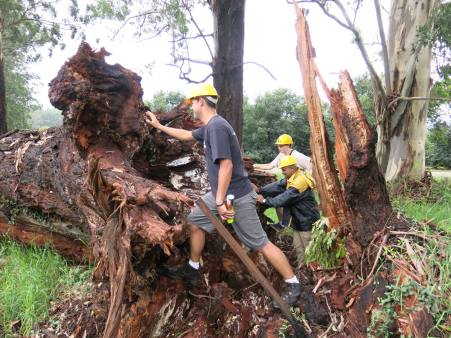
Research shows that green spaces in cities boost our own mental health, that getting out into nature (not just well-tended gardens or farms) restores balance in our own rushed lives. It’s not just the green spaces, but the pale green, bird-nest lookalike, star-shaped spaces too—trust me, I’m a doctor.
Plants may not always seem as impressive as the humans that congregate around them but they are the lungs of our planet, and keep us mentally rooted (pardon the pun). We need a few more tree doctors to make sure that they don’t simply disappear and turn to dust under our feet.

 SAYAS BLOG