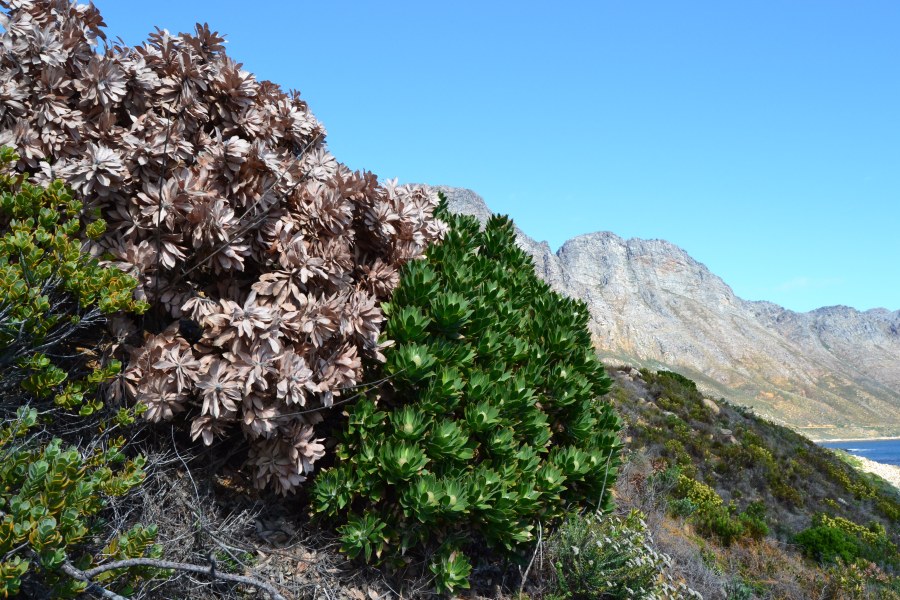
If I were a plant pathogen, I would want to be a Phytophthora species

In the spirit of Saint Patrick’s Day (March 17), lets talk about Ireland. In many Christian denominations of Ireland, Saint Patrick’s Day is considered a feast day. However, ironically, I want to talk about the Irish potato famine.

Phytophthora infestans St Pattys


Why are there so many Irish communities around the world? Because nearly 25% of Ireland emigrated as a result of mass starvation caused by a plant disease in the mid 1800s. This disease, known as potato late blight, is caused by Phytophthora infestans.


Phytophthora is a Greek word that translates as ‘plant destroyer’ (phyto=plant, phthora=destroyer).


Phytophthora is the name of a genus or group of microorganisms that destroy plants by causing disease. Microorganisms that cause disease are referred to as plant pathogens. Pathogens in this group are responsible for many plant diseases around the world. For example, as mentioned previously, P. infestans already changed the history of the world, and is still causing issues today, even in South African potato and tomato fields.

Phytophthora species are causing many epidemics around the world. Five of the top 12 tree diseases in the UK are caused by Phytophthora species. One of these is also responsible for Sudden Oak Death in the United States—my first introduction to Phytophthora. Click here to see pictures from a recent excursion into Sudden Oak Death infected lands.
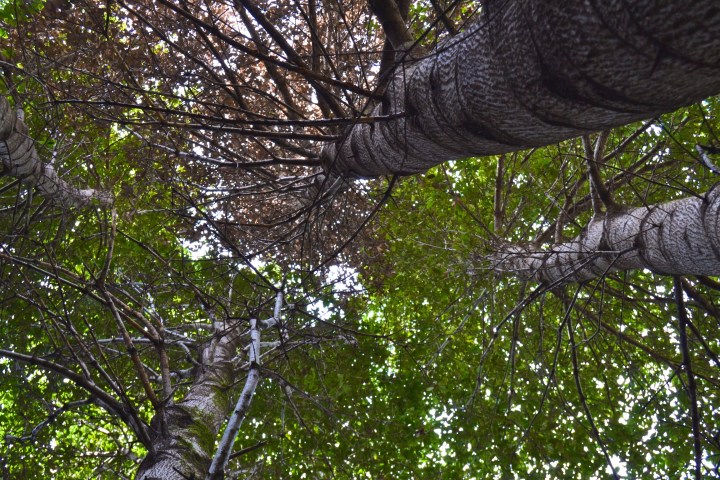
DSC_6061

Other notable Phytophthora diseases include Jarrah dieback in Australia, Kauri dieback in New Zealand, and Daño foliar de pino in South America.

Actually, the pathogen (Phytophthora ramorum) that causes Sudden Oak Death in the USA also causes ramorum blight in the UK, where it kills Japanese larch, an important timber species. One pathogen causing two major diseases on two continents! Both countries have spent millions trying to control the disease—not even counting the costs from damages, ecological impacts and increased regulations—yet South Africa may not even be looking out for it.

One species that is affecting South Africa is Phytophthora cinnamomi. This species, dubbed as the ‘biological bulldozer‘ in Australia, threatens South African proteas, orchards, vineyards and plantations. Even though this species is known to infect more than 2500 native species in Australia, we have a poor understanding of its impacts in fynbos here of South Africa.  This is one of the justifications for Cape Citizen Science, a research project focused on Phytophthora species in the Western Cape Province. You can contribute to this research and to the understanding of the impacts of Phytophthora cinnamomi by participating as a citizen scientist.

CankerSilverTree

Unfortunately, because Phytophthora species are microscopic, they are frequently (accidentally) spread around the world. I like to think we are getting better at stopping this from happening, but the reality is that more plant pathogens are introduced every year—frequently from the global trade of live plants, but also potentially from the soles of our hiking boots.

brasier

I can’t say what would happen if Phytophthora ramorum was introduced to South Africa (investigating this would be a cool research project), but after seeing the impacts of Sudden Oak Death first hand, I can say it is definitely worth watching out for. Hopefully if it is introduced, we can detected it early and eradicate it before it spreads too far to control, like it has in the UK and the USA. This is another justification for Cape Citizen Science. By reporting dying plants, you may be the first to detect a exotic and invasive Phytophthora species. The fynbos biome is immaculate because of the high amount of endemism—having many plant species that only exist here in South Africa.  Because of its incredible biodiversity, it is important to protect, and we can protect this biome by being on the look out for dying plants, reporting the ones that you come across. Cape Citizen Science is a platform for making these reports.

Even more scary than Phytophthora ramorum are the species that havn’t been discovered by science. It is estimated that between 200-500 species of Phytophthora are yet to be discovered. For example, oak trees started dying throughout California before Phytophthora ramorum was actually described and the origin of this pathogen still remains unknown. There are many Phytophthora species out there, some that may even be native to the fynbos biome. Identifying these species is another objective of Cape Citizen Science. By participating, you could be the first to collect a completely new species of Phytophthora.
 

The dangers of misinformation and miscommunication

I will start this article, I’m fairly confident, the way that no good story has ever started:

I was standing in the line at home affairs last week. I happened to strike up the usual conversation one has at these places; “Why is the line so long? Do you need photos?  (It amazes me that no one ever knows the answer to this question!) Are we going to be here so long that the sun will absorb all of our moisture and when our families come looking for us all that will remain is our tortured souls still hoping for our passports?” Having run out of things to complain about, I asked my fellow brave soul what he did for a living. He was a very high powered investment banker who also had a PhD. I learnt that day that education truly is not enough when ignorance is a dominating plague.

I wish I had told this man I was a struggling actor or an astronaut – but then again he would have had an opinion on that too. “An astronaut? Really? I heard the earth is flat and the moon is Gorgonzola. Is that true? Wait, I know it’s true. So don’t respond.” I didn’t though. Sadly I said I was a HIV researcher and his face darkened. A frown dug its way into his forehead and I could hear the 10 ton piano that was about to fall on me strain in its support. “You know,” he said in a suddenly condescending tone, “I don’t buy this whole ‘HIV’ thing. (He actually did the inverted commas with his fingers, which somehow made the whole thing worse.) I heard that it was the Americans.” I realised by the way he sneered the last part of his sentence that nothing I said was ever going to change his opinion. Valiantly I tried to explain that HIV was a zoonosis and had jumped species on at least 3 different occasions. (Read more about why this doesn’t happen that often.) I spent what felt like an entire lifetime trying to convince him about the scientific evidence. And in the end, the best line emerging from this conversation was his, “Well, you can have your opinion and I will have mine.”

The benefit of having a science degree is knowing that the most popular opinion is not always the right one. Having been trained to question everything, I’ve since understood, is not a skill everyone has. In society, the loudest (most obnoxious!) person is the one who gets heard (once again think Donald Trump) while in science you will get laughed off of a conference stage without any data. This is possibly the root of misunderstandings in science. The people listen to the strongest voice and all the while the white coats are in a corner throwing around statistics. Even when scientists are completely right, some rapper may still convince a few people the earth is flat (see this hilarious exchange between B.O.B and Neil Degrasse Tyson – thank goodness for him!).

Another huge contributor to the hall of misunderstanding and strange theories is the media. Now let me be clear; it is not just the journalists who misinterpret. It is the job of a scientist to simplify and explain their work. One of my science heroines Françoise Barré-Sinoussi (co-discover of HIV), who I was privileged to hear speak, said that at the end of your life you do not remember the journal articles you published or how high their impact number was, but the lives you have changed with the work. If you can’t communicate and translate your work, who will it ever truly benefit? I find that if you can explain your project to your Granny so she understands why you are doing it and how it may help the world, you really understand it yourself.

As a postgrad it’s easy to feel lost; to feel that your work is too far removed from any kind of real-world application. It is easy to think that you’re just doing this to get a degree. However, it’s good to communicate your science for lots of reasons: 1) you can prevent misinterpretation, 2) you can make people feel that they can engage with science and not have their heads explode, 3) you can help scientists in queues at Home Affairs retain their sanity when non-scientists begin to ask questions and 4) you can feel relevant. It’s important to remember it really is our duty to not lock ourselves in a lab, but to reach out: to teach not only the uneducated but the ignorant too. It’s up to scientists to add their voice, otherwise we may be drowned out by the loudest opinions. It’s up to us to build public trust in science. If we are only heard when there is crisis then we are never heard in calm (see this article by Tolu Oni).


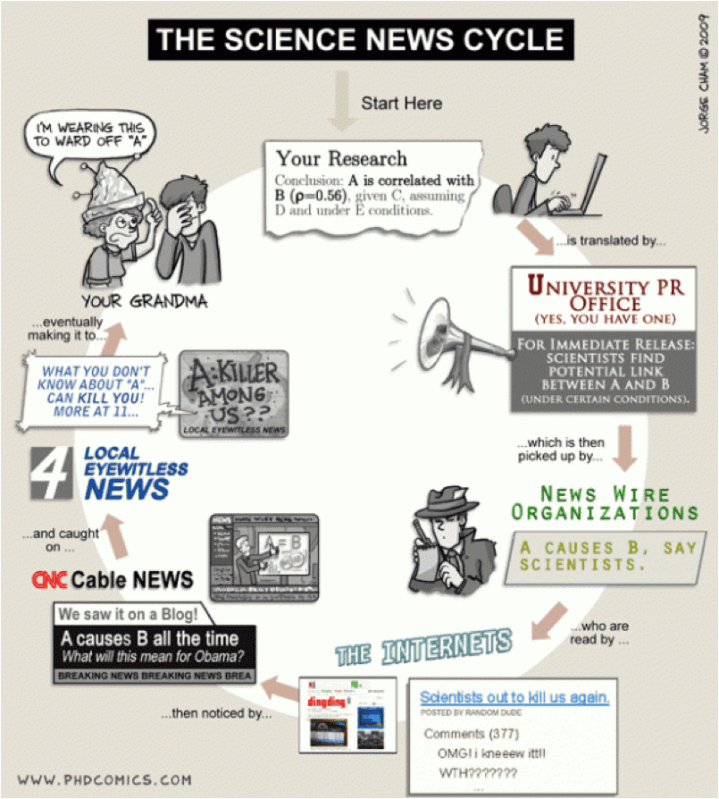
Scientist news cycle
How science communication works… (www.phdcomics.com)

There have been miscommunications that have done very serious damage too. One is most certainly the notion that vaccinating your child will result in autism (read here why this isn’t true). This has resulted in 100s of unnecessary deaths from measles in small children. Another is that HIV doesn’t cause AIDS, perpetuated by our very own ex-president Thabo Mbeki. Some “facts” are even started out of fear as a rumour: in a small town called Vulindela, wonderful things are being done by the organisation we work with (CAPRISA), to try to reduce unwanted pregnancies and HIV incidence. One of the proposed ways to do this was to insert IUDs into young girls following extensive education on the matter. The programme had to be stopped because one of the girls told all her peers that maggots would grow internally. Naturally teenage girls were then hesitant about IUDs. A far more famous case of misinformation is what happened to Hendrietta Lacks in 1951. With questionable ethical practice, doctors treating this woman took samples of her cervical cancer and made a cell line (cells that are descended from one cell and have the same genetic features) that was able to be kept in culture indefinitely. This cell line is one of the most widely used in clinical trials today; a form of which we use to test the efficacy of HIV vaccines. This woman had no idea what these doctors and scientists were doing and many years later, her family thought that she was still alive because scientists had “immortalised” her cells (Read more about this incredible story in Rebecca Skoot’s novel).

Miscommunications in science can be deadly and disturbing and we have to find ways of changing this. As a PhD student it is my job to pick the hard questions and find answers but, it is imperative that I find ways to explain the hard questions in a way that anyone can engage with them. Solutions can come from the strangest places, even the line in home affairs.