Life after data collection

So do you believe in life after death?

Awkward way to start a blog, right?  I know! If you do, then I’m sure you’ll paint me a portrait of how it’s better than your current life. Where there will be no guns, no wars and hopefully no sugar tax. I guess if you want to get out of this life alive, there’s always a need to believe in something bigger and better than rising petrol prices and the depreciation of the Rand. So why do I ask? Well, because that’s exactly how I felt about my research. If you’ve read my last blog entry, you’ll know that my Master’s journey has been nothing short of novel drama. To keep myself sane during that period, I just imagined a time after data collection where I would just analyse my data, start writing up and submit after a week. For the most part, that dream kept me going — but imagination and reality are two different things.

When things don’t go your way through the practical phase of your MSc or PhD, you imagine your last day of data collection. You daydream about how nice it will be and how you’ll virtually have your qualification in your hand.

It’s only when you actually get all that data when reality really hits you like a one ton truck. When you fill in the last digit on your diary, you breathe a sigh of relief. Happy, and reminiscing about all the days when you thought your experimental diets would run out, or when load shedding nearly killed your day old chicks; surely nothing can be worse than that. It is only when you open your Excel sheet that you realise that a new chapter in your Masters tale is about to start: your “life after data collection” chapter. Having to punch in data acquired over a seven week period is no child’s play, especially if the data that you have is for more than 10 dependent variables.

My data capturing was kind of fun, I mean I had been looking for this data for 2 years and finally I had found it. I felt like I owed it to the Almighty to push on with a smile on my face. The crazy part is that as each digit left my diary and into the excel sheet, so did my smile. By the time I finished entering my data I was tired, exhausted and so drained.

With all the data sorted, the next step was data analysis. I think this is the part most students dread. Having to sort your data is one thing, but knowing what it all mean is a challenge for most. At what level are you testing? What does the output mean? How do you express this data? I bet these questions make most postgrad students wish they had paid more attention to their Biometry lectures.

Fortunately, at University of Fort Hare, we are blessed with minds that eat data analysis for breakfast, lunch and supper. Who knew having to wake up early everyday to attend the experimental design and data analysis class would help? (Hahahaha I hope my supervisors won’t be reading this.) The thing about analysis programs, is that if you can’t speak their language then you are doomed, if you can’t tell it what you want It to do then you’re better off sleeping in your room. For me, the program was fine … the problem was with the user (me). I had an idea of what I wanted to do and how I wanted to express the data but the way I’d analysed my data didn’t allow me to. I was busy running up walls and pulling out my non-existent hair!

That was till I decide to speak to my varsity friends and mentor, Thuthuzelwa Stempa, Xola Nduku, Soji Zimkitha and Lizwel Mapfumo. Having to brainstorm my intended outcomes and data expression made an HUGE difference.

So here I am, sitting at the lab and finishing up my graphs and writing up, imagining myself walking up to collect my second degree and making my family proud. I hope that this time my imagination won’t be too far off.

So what did I learn? Life’s filled with challenges, and the very same sentiments echo through your research life. Be it admin, data collection, data analysis or writing up. Your life after data collection might be better than mine or worse, but the moral of the blog as always is about grinding it out, spin those numbers to letters and making sure you graduate in time.
 

If I were a plant pathogen, I would want to be a Phytophthora species

In the spirit of Saint Patrick’s Day (March 17), lets talk about Ireland. In many Christian denominations of Ireland, Saint Patrick’s Day is considered a feast day. However, ironically, I want to talk about the Irish potato famine.

Phytophthora infestans St Pattys


Why are there so many Irish communities around the world? Because nearly 25% of Ireland emigrated as a result of mass starvation caused by a plant disease in the mid 1800s. This disease, known as potato late blight, is caused by Phytophthora infestans.


Phytophthora is a Greek word that translates as ‘plant destroyer’ (phyto=plant, phthora=destroyer).


Phytophthora is the name of a genus or group of microorganisms that destroy plants by causing disease. Microorganisms that cause disease are referred to as plant pathogens. Pathogens in this group are responsible for many plant diseases around the world. For example, as mentioned previously, P. infestans already changed the history of the world, and is still causing issues today, even in South African potato and tomato fields.

Phytophthora species are causing many epidemics around the world. Five of the top 12 tree diseases in the UK are caused by Phytophthora species. One of these is also responsible for Sudden Oak Death in the United States—my first introduction to Phytophthora. Click here to see pictures from a recent excursion into Sudden Oak Death infected lands.

DSC_6061

Other notable Phytophthora diseases include Jarrah dieback in Australia, Kauri dieback in New Zealand, and Daño foliar de pino in South America.

Actually, the pathogen (Phytophthora ramorum) that causes Sudden Oak Death in the USA also causes ramorum blight in the UK, where it kills Japanese larch, an important timber species. One pathogen causing two major diseases on two continents! Both countries have spent millions trying to control the disease—not even counting the costs from damages, ecological impacts and increased regulations—yet South Africa may not even be looking out for it.

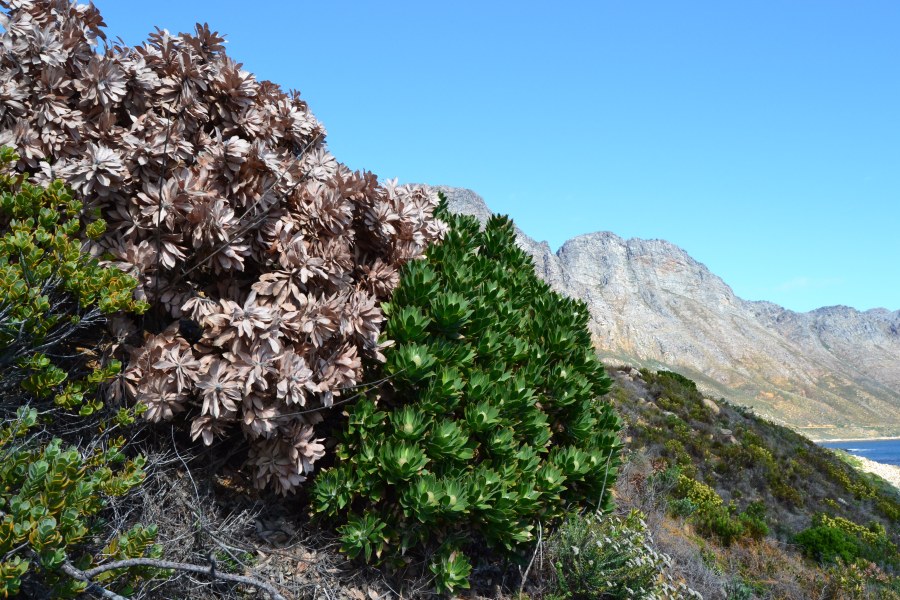
One species that is affecting South Africa is Phytophthora cinnamomi. This species, dubbed as the ‘biological bulldozer‘ in Australia, threatens South African proteas, orchards, vineyards and plantations. Even though this species is known to infect more than 2500 native species in Australia, we have a poor understanding of its impacts in fynbos here of South Africa.  This is one of the justifications for Cape Citizen Science, a research project focused on Phytophthora species in the Western Cape Province. You can contribute to this research and to the understanding of the impacts of Phytophthora cinnamomi by participating as a citizen scientist.

CankerSilverTree

Unfortunately, because Phytophthora species are microscopic, they are frequently (accidentally) spread around the world. I like to think we are getting better at stopping this from happening, but the reality is that more plant pathogens are introduced every year—frequently from the global trade of live plants, but also potentially from the soles of our hiking boots.

brasier

I can’t say what would happen if Phytophthora ramorum was introduced to South Africa (investigating this would be a cool research project), but after seeing the impacts of Sudden Oak Death first hand, I can say it is definitely worth watching out for. Hopefully if it is introduced, we can detected it early and eradicate it before it spreads too far to control, like it has in the UK and the USA. This is another justification for Cape Citizen Science. By reporting dying plants, you may be the first to detect a exotic and invasive Phytophthora species. The fynbos biome is immaculate because of the high amount of endemism—having many plant species that only exist here in South Africa.  Because of its incredible biodiversity, it is important to protect, and we can protect this biome by being on the look out for dying plants, reporting the ones that you come across. Cape Citizen Science is a platform for making these reports.

Even more scary than Phytophthora ramorum are the species that havn’t been discovered by science. It is estimated that between 200-500 species of Phytophthora are yet to be discovered. For example, oak trees started dying throughout California before Phytophthora ramorum was actually described and the origin of this pathogen still remains unknown. There are many Phytophthora species out there, some that may even be native to the fynbos biome. Identifying these species is another objective of Cape Citizen Science. By participating, you could be the first to collect a completely new species of Phytophthora.