What is at the Centre of Excellence?

In 2004, the Department of Science and Technology (DST) with the National Research Foundation (NRF) established the first seven Centres of Excellence (CoE). These Centres, based on the successful CoE models implemented overseas, were adopted to build on existing capacity and resources but also aimed to bring researchers together to collaborate across disciplines and institutions to drive science excellence.

I joined the Forestry and Agricultural Biotechnology Institute (FABI)–the host institution of the Centre of Excellence in Tree Health Biotechnology (CTHB)–in 2008 when I started my Honours degree. At the beginning on my Honours, I didn’t quite understand what the Centre of Excellence was or why it even existed. How “excellent” was this programme? Was there a need for tree health research in South Africa? I was really only concerned about doing well and learning as much as I could so that I would be a better candidate for a Master’s. But my eyes have opened up since then.

Between my classes and research project, I was encouraged to get more involved in the CoE’s activities by volunteering to be a mentor for the undergraduate mentorship programme, working in the Diagnostic Clinic (which services both the CTHB and TPCP), attending workshops run by Dr Marin Coetzee, who conducts some of his research in the CoE, and so on. The CTHB–true to the purpose of the Centres–made more room for excellence; more postgraduates could complete their studies through FABI, more essential equipment could be bought, research could include other sectors and not threaten industry-specific funding, opportunities through workshops and collaboration started to grow, leveraging funding and excellence became more important, etc. The CTHB – a virtual centre run through FABI – became a critical part of FABI and because of that, the CTHB absorbed some of its excellence, built on it and delivered its own excellence.
449rw-ho35g
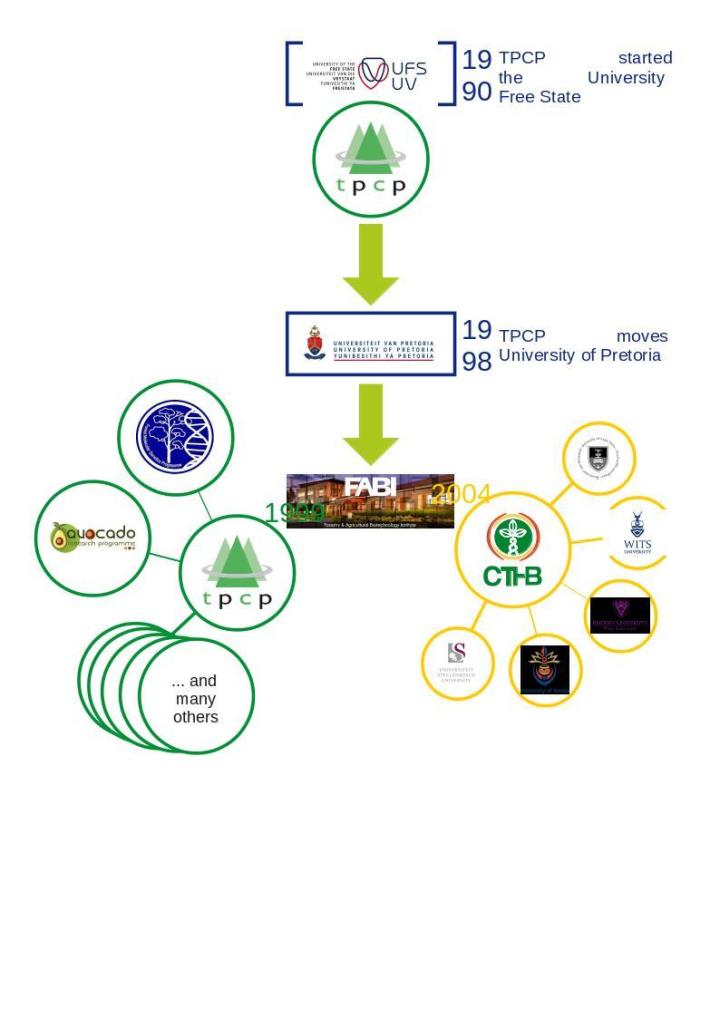
The TPCP began at the University of the Free State before moving to the University of Pretoria, where it became the founding programme for FABI. The TPCP helped start a number of other research programmes that are run out of FABI.  The CTHB started at FABI in 2004 and has linked a number of institutions to FABI and the University of Pretoria. 

I experienced how research can truly grow and have international reach. As the CoE’s research net widened, we started to identify more and more problems of concern to plant health in South Africa—many of them brought on by climate change and globalization. Because of the limited capacity in the country, back in 2004 to deal with pest and diseases that were arriving from other parts of the world, the importance of national and international collaborations and knowledge exchange became a priority. These close connections–that are still being built and expanded today–have led to growth in South Africa’s capacity; not just around FABI but at all the institutions linked to the CTHB. In 14 years, the CoE has produced 786 publications, 125 students, and really changed the ways in which we understand diseases of our native plants.

As a student associated with a CoE, I have had better opportunities for funding, wonderful teaching, mentorship, collaboration, and international exposure. Like those that have come before me, I plan to contribute to the science excellence in the country and grow more excellent people. No matter what happens to these Centres in future, as funding continues to dry up, we need to remember to keep excellence at the centre of anything we do—for us, for our country and for the world.

No matter your PhD needs, PhD Twitter has you covered…

In keeping with the spirit of being a millennial…I’m going talk about PhD Twitter and how great it is 🙂 . Before I did my PhD I hated Twitter. I found it too random, for lack of a better word. And not even lists and carefully curated content made a difference. I would login once and forget to come back for another six months. Until I started my PhD…

It started off with following the organizations I like, and then I got into PhD Twitter hashtags. #PhDchat #PhDlife #PhDadvice, #PhD… you name it. The information was still random, but now I felt connected to it. I was entertained, encouraged, and sometimes even enlightened. You cannot go 2 tweets without something that brings an emotional response out of you. And that’s why the platform is so addictive. Follow with care!

PhD Twitter can encourage you just as much as it can freak you out. Often people share horror stories of their experiences, or their disillusion with the PhD and academia…and you will wonder why you logged in. Here are some of my favourite (and not so favourite) things to engage with on PhD Twitter:

  1. Practical advice

This is a checklist on dealing with supervision. The best part for me is the comment from the PhD student, who balances this neat checklist with a little dose of reality. Some advice out there will miss the nuances of your situation, or your motivations at the time. As one of the responses state, sometimes your desperation to get into a program makes it hard to make sure your supervisor and project meet some criteria.

When you feel you can do the research and the supervisor seems nice enough, you do it.  We settle for the acceptance letter, and plan to solve all other issues later.  For better or worse. But it is good to always have this kind of advice around. PhD consultants abound on Twitter. There’s a checklist for everything.  And we don’t mind… we are begging to graduate and we are not choosers.

  1. Solidarity

Sometimes it takes only a few words to express it all, when others have had that same experience. And that is one of the most comforting feelings for any human — more so the PhD student. This person expressed a challenge without getting into detail, and was able to get support and sympathy from other PhD students. With every little word of encouragement, retweet, and heart, she felt a little better.

Even old acquaintances reached out to suggest a little coffee break…

…you can tell our PhD student hasn’t been all that reachable on the phone.

  1. Much. Relate.

Sometimes you stand in solidarity with others because you know you might need it someday, or you know how it feels to need those words of encouragement. But sometimes someone’s challenge seems like an exact replica of yours. And a comic strip captures everything that you go through or feel. When someone out there tweets about something this real, we can’t help but testify.  We say things like “I feel so attacked right now” (this is a good thing), “stop talking about my life”, and like this person, “behold, the gospel”.

  1. The dark side…

Sometimes someone will give you a little dose of reality regarding the PhD journey – the low paying academic jobs awaiting you, the poor job prospects overall, how overqualified you are for most positions, and how unsuitable you are for industry. When this advice comes from a well-rounded source it is palatable – perhaps a current academic trying to find their way in the milieu, someone who quit but found something valuable to do (“industry”, their own passions etc.).  Anybody who is not all doom and gloom.  But then there are pages like this:

Is not having any more PhD students the solution to all of challenges facing academia and society? With pages like these you don’t even do an example tweet. Just do a quick scroll through the timeline and if you are a PhD student, tell me if you aren’t scared. And discouraged. Or at least mildly concerned.

  1. PhD secrets. How many secrets can one field have?

PhD secrets are like PhD advice 2.0. They aren’t regular advice; they are things Big Academia is hiding from you! Sometimes they are educational; sometimes they are to the tune of number 4 above. These secrets are multifaceted. Some hide in plain sight…

Some are really, really magical hacks you would otherwise have not uncovered…

Who knew changing the name of a file you have been working on forever could give you a new lease on life? Changing your perspective on something changes how you deal with it for sure. Sometimes we make things harder for ourselves by thinking they are more complex than they really are. And little mental hacks like these are the little miraculous things that we didn’t even know could unlock our creativity and keep us going.

  1. Big ideas on the PhD in the 21st century…

Through PhD Twitter you get access to all of the latest ideas on how universities can reinvent the program and stay valuable to society.  Through these ideas, we as students can also see where our careers are headed. We know that change is inevitable, and graduate programs will have to continually evolve to fit better into their contexts. This means negotiating our own place in it, thinking about the meaning of what we do, and because we are the custodians of the future PhD …maybe even think ahead on the best way to advance science and the PhD in the future.

These are just six of the multitude of things you encounter during a brief session of PhD Twitter. Sometimes I get tired of the self-obsession of the platform. But sometimes it’s the only thing that can keep me going. A little bit of hope goes a long way. And virtual hugs sometimes work.  PhD twitter is great. Anyone, big or small, can have a say in things. Get advice. Feel connected to a bigger picture. All at the tap of an app…