The joy of ignoring scientific fence lines

I think science should be fun. Sure, I am still young and might not know what I’m talking about, but I’m going to spend the better part of my life in natural science research. That is time I will never get back. I therefore must ensure that it is the best time of my life. I want to spend most of it being happy, not depressed. So then, how do I ensure that I am happy?

I’ve talked about balancing work with social interaction (especially with your family). But now I’ve rediscovered something: exploring! I’ve just spent a weekend as research assistant on a behavioural-ecology undergraduate field excursion. Behavioural ecology — the study of the evolutionary basis for animal behaviour due to ecological pressures — is not really my field; I’m more into environmental health research. However, as an assistant who was supposed to lead a team and help the students interpret animal behaviour, I found myself learning more than they did. The techniques and the data analysis used in this field just amazed me. How one translates a mere behavioural observation into a scientific conclusion really changed my perspective about natural science research. And as I was listening to different students presenting their findings at the end of a very long basic research day, I remembered why I wanted to do this whole science thing in the first place. Most importantly, now that I’m back in the middle of my MSc proposal, I derived a few lessons that I believe will make my life a little bit better.

Figure 1 Observed ungulates on the GGHNP Mountains
Ungulates in the Golden Gate mountains

Firstly, most of the research that we do is not informed by just a single discipline. We fool ourselves if we think that’s possible. No matter your field, there is an aspect of your research that needs the expertise and justifications of another field. This is why it didn’t come as a surprise to me to find out that my research has a lot of justification from chemistry, even though I am in biological sciences. Yes, I was frustrated wading through the chemistry literature, but now I know it’s all worth it. It’s the joy of discovering something unexpected – like a treasure buried in the sand – which you wouldn’t have found if you just stuck to walking down the path.

Secondly, one cannot be stereotyped in research. There are many things that are happening in and around what one is doing. A colleague and his group were observing the behaviour of ungulates. They measured things like wind speed and the local temperature. If someone had told me this a couple of months ago I would have asked, “Why in the world would one measure that? It’s just animal behaviour?” But these affect the behaviour of the animals too; kind of how we also change our behaviour when it is cold or too windy. There really is a lot going on. I think if we can be aware of what is going on around us, our research sites, laboratories, and even in our little spaces, we can eliminate some part of the stress and have fun. Also, hearing about somebody else’s problems always makes your own seem smaller 😉

Figure 2 Science disciplines, like atoms of a molecule, are interlinked somehow

Lastly, things aren’t always as they seem. Everything is interconnected, in sometimes unexpected ways. This is true by the mere definition of behavioural ecology. But looking at other fields in science also, we really need to tap into why things are happening. It is true, we need to invent and modify to better our world but we also need to find out why things are happening and work on research that is intended at eliminating the factors that are influencing the problems we have in the world today. And we can’t do this without looking at outside factors, other fields that we’re maybe not trained in. Physiology can change because of physics and chemistry – and all of this is linked to ecology and economics!

I still have no idea what “science” should look like, but I am busy reading a friend’s research in chemistry. I enjoy forensic pathology documentaries and every chance I get, I take ten minutes to read up on psychology research. It is not because I have too much time on my hands. I think all the disciplines may be interlinked somehow, and as we embark on these postgraduate studies, we have to be open-minded and inquisitive. Like children, playing. Coming up with new research ideas and justifying what we do will be easy this way. That is the beauty of science. That is how we get to excel in science.
International Day of Women and Girls in Science: why not to like it!

By Roula Inglesi-Lotz

“I was never sure if I liked the idea of an international Woman’s Day and now #InternationalWomeninScienceday. I want to live in a world where the self-evident is not a reason for celebration. We ARE Science! Celebrate us at the workplace everyday”.

That was my twitter post last week- I felt alone in the downpour of celebratory messages, posts and stories for International Day of Women and Girls in Science.

My post might have been perceived as sour and bitter and to a certain extent, it was. To explain myself, I am not a big fan of International Days – we have too many and they’ve started to lose their real meaning. In addition, I have a feeling that International Days are established for the weak, the lesser known causes, the ones that do not attract attention the rest of the year. So, being the target of an International Day makes me feel weaker, rather than stronger.

Roula1
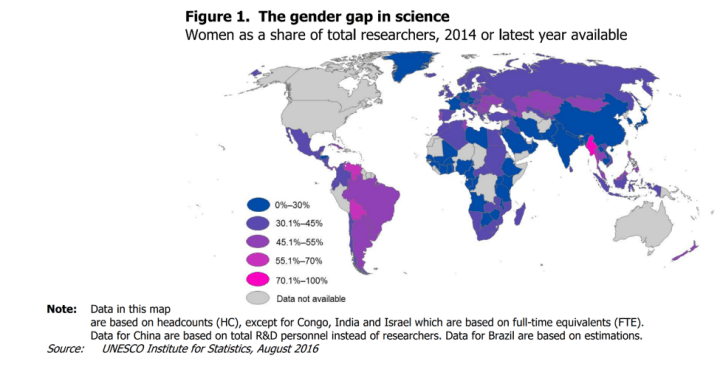
Source: http://uis.unesco.org/sites/default/files/documents/fs43-women-in-science-2017-en.pdf


Yes, you guessed right! I am one of those people that are NOT counting the days to Valentine’s (although some roses, chocolate and a romantic dinner is always welcome). Which is exactly my point: Yes, let’s talk about women in science one day a year, but daily/regular “flowers, chocolates and romance” is what makes the celebration substantial, until there is no reason for acknowledgement of the issue. I mean, have you ever seen an international day of CEO’s?! It’s only for secretaries.

I would rather live in a world where:

  • women in science are not a minority – in 1987, 20% of STEM researchers worldwide were women, in 2018, still only 22% (thestar.com);
  • there are not special awards for women (how about all scientists competing — and evaluated without bias — against each other?);
  • when applying for jobs, women are not evaluated based on how many kids they have or want (paternity leave is still not = maternity leave);
  • people are not surprised (or shocked) when they hear a CEO or HOD is a woman;
  • young talented girls and great minds do not miss opportunities because they have to provide for their families or because they are disadvantaged compared to their male siblings;
  • infrastructure (both capital and emotional) is constructive and supportive of women and — let me also say — mothers in the work environment;
  • where a girl in Engineering or Programming doesn’t feel excluded;
  • women’s experiences and local knowledge are not ignored, especially in the developing world;
  • where women are full, active participants in the scientific community.

Roula2

In the world right now (unfortunately), an International Day might be a good tool to shape this “new” world I am dreaming of.

But it is certainly not enough. We need to celebrate women’s perspectives every day. We (women) need to support each other and advocate for each other. We need to provide role models, support motivation and inspiration for early career women academics and the girls of the future. We have to make sure we assist and reward young girl scientists from the very beginning and all the way up, also for those already deep in the biased system; but most importantly, we must support women in following their dreams.

Easier to say than done, I guess. It needs an ethical code and an inner drive by women to “show off” their strengths. At the same time, it needs support, programmes and practical assistance from policymakers and society as a whole.

I hope that I will live in that world one day where being a woman in science is not an exception, where there is no need to celebrate every single woman in science as we will be the norm –nothing special – just us!

Women in science are not competitors to men in science; they are the missing puzzle pieces. Only by working together and learning from each other, can the human race (and science!) progress.


P.S. (Here I am again…) Having said all that and raising two boys, I have to emphasise that we should not underestimate the importance of boys’ education (formal and family), as well as maintaining gender perceptions and biases. However, that’s a long discussion… for another time.