Exciting times for HIV vaccines, less exciting times for the virus

On International HIV Vaccine Awareness Day (the 18th May 2016) at the HIV Vaccine Trial Networks (HVTN) meeting, it was announced that for the first time in 7 years and the first time in Africa, a HIV phase 3 vaccine trial will be taking place. In addition to this the world’s first HIV antibody infusion trial started with its first South African participant in Soweto.

Slowly we seem to be completing a puzzle. Perhaps the most complicated one ever pieced together.

Science is a developing story. Every study, no matter how mundane, adds a puzzle piece to the picture. Sometimes it’s an edge piece, that forms the basis for studies to come and sometimes it’s a middle piece that doesn’t really help anyone at the time but will be imperative to complete the picture. In some cases though, in order to progress, scientists stop fitting in pieces to the main puzzle and start their own. This is a risk because the evidence is leading the field in a particular direction and this direction is fairly certain because multiple people have determined the same thing. Sometimes though, the risk of deviating is worth it. Risk shakes up the field; breaks down dogma and enforces flexibility. And that is what this trial could mean for HIV vaccinology.

I am beyond excited that we are having our first trial in seven years and I’m even more excited that it is happening in South Africa. Capacity building has happened over the last couple of years, allowing for South African clinicians and scientists to run these trials. This means much more opportunity for young scientists, collaborations, funding and all round focus. We are finally in the spotlight. The findings of trials always mean that interest in the field surges again. New ideas will be emerging from unexpected places.

The most recent vaccine trial regimen that showed any protection was the U.S. Military HIV Research Program-led RV144 clinical trial in Thailand completed in 2009. This regimen showed that protection was mediated by something we did not expect. All our data in the field up until that time suggested that antibodies (called broadly cross neutralizing antibodies) that could bind and coat lots of different HIV viruses (preventing entry into cells) would be our best shot at a vaccine. But protection (bear in mind it was only 31%) was achieved by antibodies that weren’t able to block infection of a cell. Instead they are able to bind to an already infected cell and call for backup. Other cells with the ability to secrete substances that pop the infected cell heed the call and come to destroy the infected. Think of the broadly cross-neutralizing antibody as Batman (pretty capable

robin batman 1
http://www.quotesgram.com

of a fight on his own) and these other antibodies as Robin. The vaccine was tested in Thai people who have a very different epidemic to the part of the world that bears the greatest burden, Southern Africa. So the HVTN has run a series of small trials in South Africans using a vaccine that would be more appropriate for our situation. And now, we are paving the way to HVTN 702 (not to be confused with the talk radio station); the phase 3 trial guaranteed to rock the boat of science.


A phase 3 trial is a big deal. A wide range of criteria need to be fulfilled in order to proceed to one and the criteria that were set for HVTN 702 have all been met. However there is much talk in the field that we are progressing for progress’s sake. Many feel like we are creating a vaccine that has both arms tied behind its back and we are expecting it to win an arm wrestling contest. We are expecting robin to win Batman’s fight.  We are pushing a vaccine through that does not create the antibodies we know are going to protect people and are based on historically unimpressive antibodies. Should we be doing trials on things we know are not optimal or should we take the risk and acknowledge that there are clearly things we do not understand? Perhaps what now seems like an arbitrary puzzle piece will start off a new and exciting puzzle.

hero sidekick5400 South Africans will be enrolled from November 2016 and we will know the outcome by 2020. It’s a long time to spend on something that may not work again. What would going back to the drawing board mean for new infections? The bottom line is we have not yet managed to summon Batman to fight for our cause. We have lots of ideas on how to get him there but so far nothing has worked. Should we give up on Robin just because he is not what we expected?

Most vaccines have taken between 25-50 years to develop, so technically 30 years in, we aren’t doing too badly: we have drugs that are very effective at keeping AIDS patients well, which our government has now pledged to provide free of charge to everyone infected; we have drugs that can be used to prevent infection (pre-exposure prophylaxis) and we have lots of ideas bout what will protect people in a vaccine setting.

For me, the proof will be in the pudding. By 2020 we may have even brighter ideas about what we need and how to get there. And potentially the pessimistic view of the current phase 3 if irrelevant if it goes on to form new dogma. If all this phase 3 trial does is encourage bright and motivated young people to tackle arguably one of the most perplexing problems the world has, it will be a win. Either way, now is not a good time to be HIV.
The dangers of misinformation and miscommunication

I will start this article, I’m fairly confident, the way that no good story has ever started:

I was standing in the line at home affairs last week. I happened to strike up the usual conversation one has at these places; “Why is the line so long? Do you need photos?  (It amazes me that no one ever knows the answer to this question!) Are we going to be here so long that the sun will absorb all of our moisture and when our families come looking for us all that will remain is our tortured souls still hoping for our passports?” Having run out of things to complain about, I asked my fellow brave soul what he did for a living. He was a very high powered investment banker who also had a PhD. I learnt that day that education truly is not enough when ignorance is a dominating plague.

I wish I had told this man I was a struggling actor or an astronaut – but then again he would have had an opinion on that too. “An astronaut? Really? I heard the earth is flat and the moon is Gorgonzola. Is that true? Wait, I know it’s true. So don’t respond.” I didn’t though. Sadly I said I was a HIV researcher and his face darkened. A frown dug its way into his forehead and I could hear the 10 ton piano that was about to fall on me strain in its support. “You know,” he said in a suddenly condescending tone, “I don’t buy this whole ‘HIV’ thing. (He actually did the inverted commas with his fingers, which somehow made the whole thing worse.) I heard that it was the Americans.” I realised by the way he sneered the last part of his sentence that nothing I said was ever going to change his opinion. Valiantly I tried to explain that HIV was a zoonosis and had jumped species on at least 3 different occasions. (Read more about why this doesn’t happen that often.) I spent what felt like an entire lifetime trying to convince him about the scientific evidence. And in the end, the best line emerging from this conversation was his, “Well, you can have your opinion and I will have mine.”

The benefit of having a science degree is knowing that the most popular opinion is not always the right one. Having been trained to question everything, I’ve since understood, is not a skill everyone has. In society, the loudest (most obnoxious!) person is the one who gets heard (once again think Donald Trump) while in science you will get laughed off of a conference stage without any data. This is possibly the root of misunderstandings in science. The people listen to the strongest voice and all the while the white coats are in a corner throwing around statistics. Even when scientists are completely right, some rapper may still convince a few people the earth is flat (see this hilarious exchange between B.O.B and Neil Degrasse Tyson – thank goodness for him!).

Another huge contributor to the hall of misunderstanding and strange theories is the media. Now let me be clear; it is not just the journalists who misinterpret. It is the job of a scientist to simplify and explain their work. One of my science heroines Françoise Barré-Sinoussi (co-discover of HIV), who I was privileged to hear speak, said that at the end of your life you do not remember the journal articles you published or how high their impact number was, but the lives you have changed with the work. If you can’t communicate and translate your work, who will it ever truly benefit? I find that if you can explain your project to your Granny so she understands why you are doing it and how it may help the world, you really understand it yourself.

As a postgrad it’s easy to feel lost; to feel that your work is too far removed from any kind of real-world application. It is easy to think that you’re just doing this to get a degree. However, it’s good to communicate your science for lots of reasons: 1) you can prevent misinterpretation, 2) you can make people feel that they can engage with science and not have their heads explode, 3) you can help scientists in queues at Home Affairs retain their sanity when non-scientists begin to ask questions and 4) you can feel relevant. It’s important to remember it really is our duty to not lock ourselves in a lab, but to reach out: to teach not only the uneducated but the ignorant too. It’s up to scientists to add their voice, otherwise we may be drowned out by the loudest opinions. It’s up to us to build public trust in science. If we are only heard when there is crisis then we are never heard in calm (see this article by Tolu Oni).


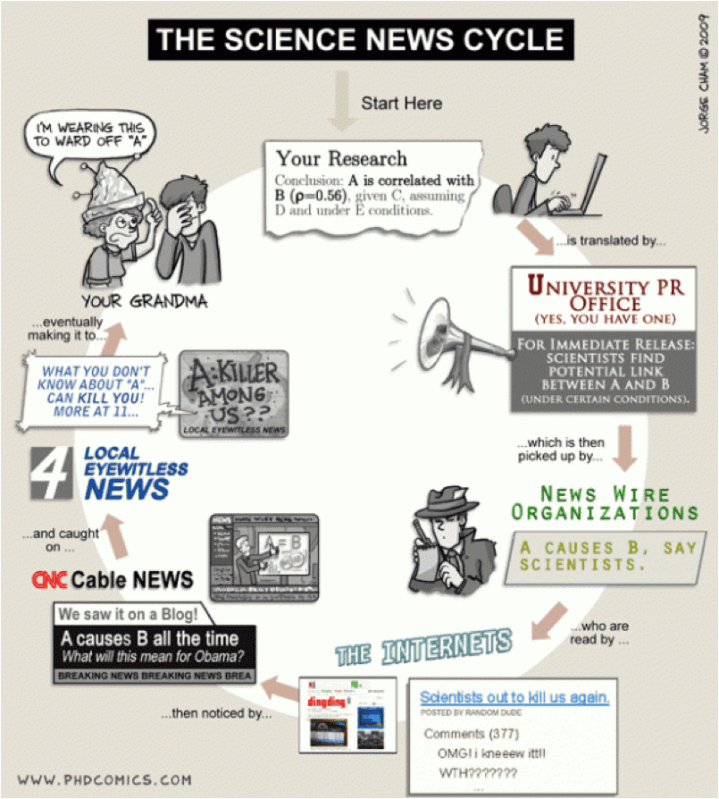
Scientist news cycle
How science communication works… (www.phdcomics.com)

There have been miscommunications that have done very serious damage too. One is most certainly the notion that vaccinating your child will result in autism (read here why this isn’t true). This has resulted in 100s of unnecessary deaths from measles in small children. Another is that HIV doesn’t cause AIDS, perpetuated by our very own ex-president Thabo Mbeki. Some “facts” are even started out of fear as a rumour: in a small town called Vulindela, wonderful things are being done by the organisation we work with (CAPRISA), to try to reduce unwanted pregnancies and HIV incidence. One of the proposed ways to do this was to insert IUDs into young girls following extensive education on the matter. The programme had to be stopped because one of the girls told all her peers that maggots would grow internally. Naturally teenage girls were then hesitant about IUDs. A far more famous case of misinformation is what happened to Hendrietta Lacks in 1951. With questionable ethical practice, doctors treating this woman took samples of her cervical cancer and made a cell line (cells that are descended from one cell and have the same genetic features) that was able to be kept in culture indefinitely. This cell line is one of the most widely used in clinical trials today; a form of which we use to test the efficacy of HIV vaccines. This woman had no idea what these doctors and scientists were doing and many years later, her family thought that she was still alive because scientists had “immortalised” her cells (Read more about this incredible story in Rebecca Skoot’s novel).

Miscommunications in science can be deadly and disturbing and we have to find ways of changing this. As a PhD student it is my job to pick the hard questions and find answers but, it is imperative that I find ways to explain the hard questions in a way that anyone can engage with them. Solutions can come from the strangest places, even the line in home affairs.