Return of an expat: concerns and opportunities


There are many blogs and YouTube videos showing what the rest of the world gets wrong

2
Source credit: http://www.generationcedar.com/main/2013/02/the-true-meaning-of-home-lies-in-our-true-identity.html

about our beautiful country, some of it funny, some of it quite horrifying. As a young African explorer and traveler, I have been asked all the clichéd questions… “Do I have pet lion?” or even worse – “Have you walked to Nigeria?” Because you know, it’s all in Africa. Here, I want to give you a

taste of the cultural clashes and surprising culture shocks you might experience should you start using your student passport seriously.

Firstly, I think we South African are more prepared to travel the world, because we are regularly exposed to multiple cultures and languages back home. When I did my MSc degree in Korea (the “good” one!), I discovered quite the language barrier. English is not an official language over there, and very few schools use English as a medium of instruction. But, when I mentioned that South Africa was multilingual society and the average South African speaks more than 3 languages, people were flabbergasted. It made me realise how much of a mono-culture Korea was, and I missed our crazy diversity. I became involved with the South African Students(?) in Korea group – not to cling to my past, but to find people that shared my ‘rainbow nation’ mind-set. It was here that we had a space to discuss our academic concerns and speculate about opportunities that existed back home. It was during our meetings that we laughed and swapped stories; we used humour to mask the pain and ridicule that we felt being outsiders in this mono-cultural society.

Source credit: https://kr.pinterest.com/pin/109001253456956116/

When I later moved to Canada, though, I was not ready for the whole new set of expectation and questions that I’d face in North America. Here, academics were generally concerned with the life quality of South African university students (the #feesmustfall movement has captured the world’s attention). I must admit it was refreshing to converse about the status quo in south Africa – even though I admit I’m not an expert on the topic.

I find there are major differences between the east and west- notably, in the east it is often asked, “When are you going back to your country?” and here I get asked, “ So, have you decided where you will settle in Canada?” It is always shocking when I tell my colleagues that I have every intention of going back home (why would I stay in a place that gets over a metre of snow on random Tuesday- THAT is another story).

Source credit: https://kr.pinterest.com/pin/109001253456956116/

There is a lovely mix of people within the South African diaspora community: some who have no intention of returning home and those of us who recognise the potential impact/significance of our contributions to the South Africa academic landscape. Those of us wanting to return often share similar concerns- Have we been gone too long? What opportunities exist for someone with a foreign qualification? What is the academic landscape like now and how is it evolving? Is there a niche for my work? Would we be able to integrate back into mainstream south Africa? What challenges await us? When you have been gone for as long as I have, these questions are enough to give you mild anxiety and keep you up at night.
Over the rainbow

Knee-high in snow and clinging to memories of how the African sun warmed my skin and heart, I reflect on my journey from the rainbow nation to francophone Canada. This is a tale like no other; it is neither “rags to riches” nor “tragedy”, but a simple quest for scientific excellence mixed with adventures of a travelling South African.

My undergraduate studies were rather uneventful. If I’m honest, like many of my peers, it was time of experimentation and self-discovery. Throughout my journey of self-discovery it became clearer to me what I wanted to do for a job and career. Similar to many of my peers, I was being thrust forward into an Honours degree, and when I was a young 20-something graduate, it dawned on me that the dream I had had was not bold enough.

Post-graduate realisation[1] hit me hard and I did what most graduates would not dream of – I took a gap year. It was during this self-imposed ‘sabbatical’ that my yearning for traveling the globe grew even out of hand. I remember thinking, “ a BSc in Ecology and Zoology is not what it used to be…” Of course, I wasn’t sure what a BSc in Ecology and Zoology should be, but I knew it wasn’t It anymore. Nonetheless, I was determined to make something of myself and pursue my dream of becoming a world-renowned ecologist.

Then I got the chance to visit a friend who was teaching English in Seoul, South Korea, and the food, the people, the culture all conspired to draw me to east Asia. But I wasn’t just playing around, there is a certain bravado and courage that we South African posses that sets us apart from the rest of the world. And, I had the guts to approach the leading professor in soil ecology at Korea’s top university (Seoul National University). I boasted about South Africa’s gorgeous, unique Fynbos. Immediately, I was the new shiny toy in the box. The beauty and complexity of the Fynbos is the envy of many ecologists, and I managed to start a project with one foot in Asia and one still in Africa. That was just the beginning of my postgraduate adventures, almost all of it built on the back of people skills and love of Fynbos. Who knew ecologists had to be such good psychologists?

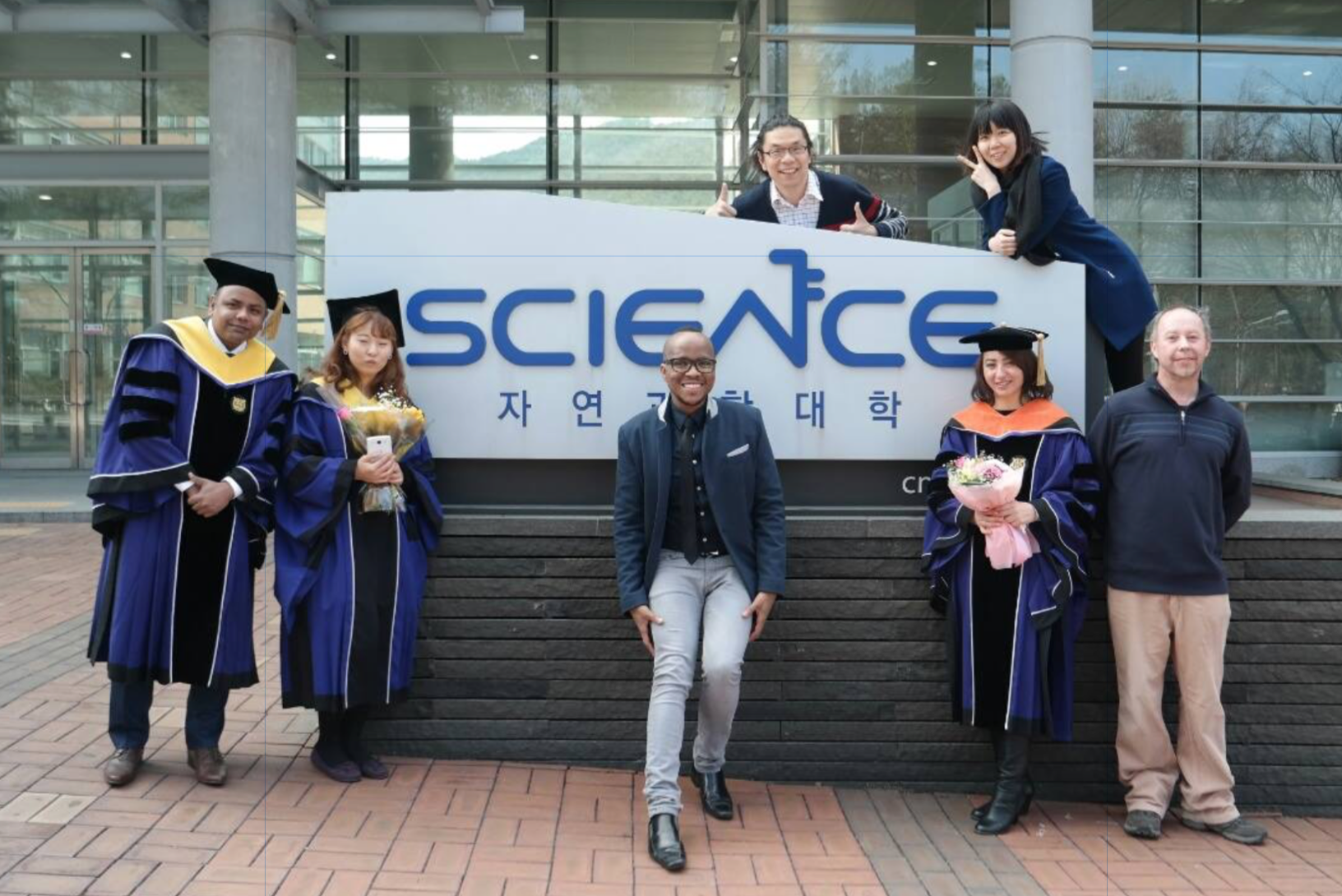
Graduation at Seoul National University

Upon graduation, I began to pack up my life once more and prepare to move to Canada where I would start my Ph.D. I must admit, I love everything about travelling: the airport, new cultures to explore, and — most important — the chance to make new friends. But, I have always said, “I came here with 1 bag and will leave here with 1 bag”. In principle, this rule would serve you well, but when you have lived in a new country for 2 years, you will accumulate stuff. Packing up your life into a 20kg bag arouses feelings of catharsis and reinforces the feeling of excitement about moving to a new place (out with the old, in with the new kinda feeling). Little did I know that moving to a ‘western’ country after being immersed in Asian culture would come with its own challenges, but that’s a story for another blog.


[1] The realisation that a bachelors degree will not suffice and guarantee the kind of job or future that you were day dreaming about during first-year.