Becoming unstuck: how to keep on writing

I am approaching the halfway checkpoint of my doctoral training and research. As I previously mentioned (here and here), I am doing my Ph.D in biology and my work is deeply rooted in the hologenome concept of evolution. I consider myself to be very fortunate to have a supportive/encouraging mentor and amazing technical support to excel in my work. At this stage in my programme, I have my comprehensive exams in a few weeks and it is a very stressful period for any student. In my recent blog, I discussed tips and methods that keep my awake and focused. Here, I want to discuss how to become unstuck when you have been writing for too long and you feel like your brain is about to unhinge 😉 .
phd 2 copy

Of all the aspects of the scientific process- I thoroughly enjoy the writing processes and I find it to be very cathartic to see your ideas on paper, or on your computer screen. However, like many before me, mental fatigue can take its toll on my writing capability. This is my fourth attempt at putting the blog post together! One of my favourite scientific bloggers and academic Raul Pacheco-Vego (@raulpacheco) wrote a brilliant piece on how to become unstuck. In it, he discusses the five strategies that he uses: 1) write an outline, 2) set writing targets, 3) answer questions regarding your work/topic, 4) read a paper and synthesise it, and 5) go for a walk with a pen and jot down ideas as they come to you. As always, he gives pertinent advice on how to increase productivity and writing. I have spent the past week experimenting with different approaches/strategies to get myself unstuck and get back to writing.

It was only when I stepped away from my work/writing for a whole day that the words started coming back to me. Now, I must confess the dreaded ‘monkey demon of PhD guilt’ — eloquently summarised by Katherine Firth (@katrinafee) — is a reality. And, it was only when I understood and tamed my monkey demon that I was able to relax and come back to my work more focused. I take a day off work and I do not think about my work or even discuss it. I find that keeping active and doing tasks that do not require a lot of thinking helps. Now, I hear you asking yourself- what does he do on his off day? Well, I love the being outside and I also take this time to clear up things at home. Often, we get so consumed with work and we tend to let some things at home fall behind. For instance, I use this day to separate my recycling garbage bin and some ironing. I also go for extended walks and picnics in the botanical garden near my house.

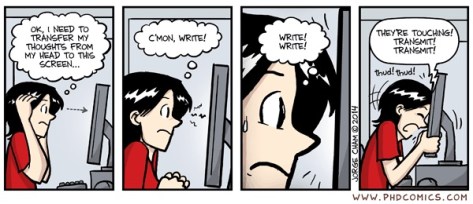
One of my friends uses this day to catch up on movies and TV series; frankly, I have never been one for TV. Some draw inspiration from comics… How about you, dear reader, how do you break your writer’s block? Is there a special hobby or regimen you follow to get yourself back in your writing zone?

PhD comics copy

Born as a side-line

By: Guest-blogger Dorothy Ngila – @DorothyNgila  


I had worked at the Academy of Science of South Africa (ASSAf) for just over 4 years, when I had a light bulb moment during a side-line discussion at a global academies’ meeting on the social determinants of health. Somebody just casually asked whether we knew the numbers of women participating in academies of science, globally. Having been steeped in so much background information on women’s status as a scientific minority, I immediately knew that a survey of women’s participation in national science academies was probably a good idea.

I also knew from scholarly literature that hard evidence would tell this narrative differently, and perhaps contribute to change.

And so the survey that would collect, analyse and report on participation of women in science academies was born. The InterAcademy Partnership (formerly IAP: The Global Network of Science Academies), the Organization for Women in Science for the Developing World, the Women for Science Group of the Inter-American Network of Academies of Sciences (IANAS) and ASSAf endorsed the idea with IAP funding the project. Working together with Dr Nelius Boshoff, Stellenbosch University (the lead researcher on the project) we revised the terms of reference and began the arduous journey of contacting science academies, convincing them of the importance of this data. For a few academies it was easy to submit data in the format that we required it: number of women members, the total female membership, membership per discipline, women’s participation in the academy’s activities, women’s participation in academies’ governance… It was easy because they had already been collecting this type of data. For others, it was simply too much of an ask, and we never managed to get any information.

This process alone convinced me of the importance of the survey. How was this not a significant area of preoccupation for academies?

Fast forward to the analysis of the data we eventually received from 63 academies of science. I knew from the anecdotal information that the numbers were really low, but I was really shocked when it emerged that the global membership of women in science academies was only 12%. I expected the number to be low but not that low. However, I was elated to learn of the major strides that academies of science in Latin America have made in terms of women’s participation. The Cuban Academy of Sciences (27%) and the

Caribbean Academy of Sciences (26%) rank at the top, globally, in terms of female membership. Also our very own ASSAf ranks among the top five organisations as far as women membership is concerned (24%).

Of course the low numbers correlate to the current data on women’s representation in leadership, and in science leadership. Academies of science admit accomplished and well-established science leaders in their different scientific domains and nations to their membership. So, the data clearly mirrors the major global challenge we have in retaining women in science leadership.

And so what was the big lesson from the study? For me, it was the importance of data! Recent, accurate and reliable data. Gender equity and equality strategies, policies and plans must be informed by evidence.

The study recommends that academies must collect, analyse and report gender-disaggregated data on participation in activities, membership and governance. Gender-disaggregated data provides the opportunity for critical thinking on the status quo and better planning for the future. It is only when we are faced by the hard facts that we can start really acknowledging and addressing the problem.

This survey started as a side-note to a bigger conversation, and if a group of concerned, passionate and dedicated people within and around the academy movement did not run with the idea, we would not have baseline data that confirms what we have known for a long time… women are simply too few in science leadership! Many academies do now realise the importance of urgent action from their side to address gender equality and equity within their ranks. It is my hope that the survey results continue to trigger more conversations and actions amongst academies of science on their role in advocating for increased participation of women in the national systems of innovation they serve.  It can no longer be a mere side-note issue.