A WATER HUNGRY NATION: Yearning for fire-pool downpours from heaven

We must pray for His divine intervention!!!… But we must not pray like those who do not have faith…” While you may think that this is a sermon, it is a cry from the Minister of Water Affairs to the nation to pray for the heavens to open up, the rains to kiss the barren African soil. I must say that while this approach amused me, it is astounding that in 2017 we still experience water shortages – there is water available.

Let us be frank in that these issues culminate from historical recklessness of a nation vying for economic growth. Still trekking towards development, the country relies heavily on mining, coal power and agriculture to sustain the economy. Our progress is, ironically, messing with our most basic of human needs – the need for clean water. The Olifants River, which meanders through the Mpumalanga Province, lined with mining operations and coal power stations flanking the banks, serves as an appropriate example. Massive crocodile and fish deaths were reported in 2006 in the Olifants tributary running through the Kruger National Park; shortly afterwards, the same was reported at the Loskop Dam. The areas affected by this tragedy are national heritage key-points, highlighting the importance of resolving these issues.

The quality of our water is a tremendous issue – humans, plants, and animals rely on clean fresh water, and researchers who investigated the Olifants River tragedy could not pin-point the cause of all these mysterious deaths. So, what is to prevent the tragedy from repeating itself elsewhere?

Crocodile and fish mortalities reported at the Kruger National Park, as well as Crocodylus niloticus and C. gariepinus with white and brown spots in fat (from Olifants gorge on Mozambique border and Letaba confluence)

In efforts to find the cause of these mysterious deaths, the research I have undertaken through my  Master’s into Doctoral studies is aimed at assessing the risk and levels posed by persistent organic chemicals at the Loskop Dam, using zebrafish as a model system. Preliminary findings have revealed high levels of these compounds and their contribution to the toxicity of the system.

This 18th year of the twenty-first century is marked as one where I get closer to the answers that have boggled many a scientist and national parks authorities. Why are our aquatic organisms dissipating, who and what is responsible, how is the wider population affected by these incidents, what can be done to prevent and revive the ecosystem!? Through the eye of a fishy needle, if you will, I will highlight some hard-hitting truths… And perhaps the final chapter of my thesis will be named REVELATIONS, rather than CONCLUSIONS!!!
Over the rainbow

Knee-high in snow and clinging to memories of how the African sun warmed my skin and heart, I reflect on my journey from the rainbow nation to francophone Canada. This is a tale like no other; it is neither “rags to riches” nor “tragedy”, but a simple quest for scientific excellence mixed with adventures of a travelling South African.

My undergraduate studies were rather uneventful. If I’m honest, like many of my peers, it was time of experimentation and self-discovery. Throughout my journey of self-discovery it became clearer to me what I wanted to do for a job and career. Similar to many of my peers, I was being thrust forward into an Honours degree, and when I was a young 20-something graduate, it dawned on me that the dream I had had was not bold enough.

Post-graduate realisation[1] hit me hard and I did what most graduates would not dream of – I took a gap year. It was during this self-imposed ‘sabbatical’ that my yearning for traveling the globe grew even out of hand. I remember thinking, “ a BSc in Ecology and Zoology is not what it used to be…” Of course, I wasn’t sure what a BSc in Ecology and Zoology should be, but I knew it wasn’t It anymore. Nonetheless, I was determined to make something of myself and pursue my dream of becoming a world-renowned ecologist.

Then I got the chance to visit a friend who was teaching English in Seoul, South Korea, and the food, the people, the culture all conspired to draw me to east Asia. But I wasn’t just playing around, there is a certain bravado and courage that we South African posses that sets us apart from the rest of the world. And, I had the guts to approach the leading professor in soil ecology at Korea’s top university (Seoul National University). I boasted about South Africa’s gorgeous, unique Fynbos. Immediately, I was the new shiny toy in the box. The beauty and complexity of the Fynbos is the envy of many ecologists, and I managed to start a project with one foot in Asia and one still in Africa. That was just the beginning of my postgraduate adventures, almost all of it built on the back of people skills and love of Fynbos. Who knew ecologists had to be such good psychologists?

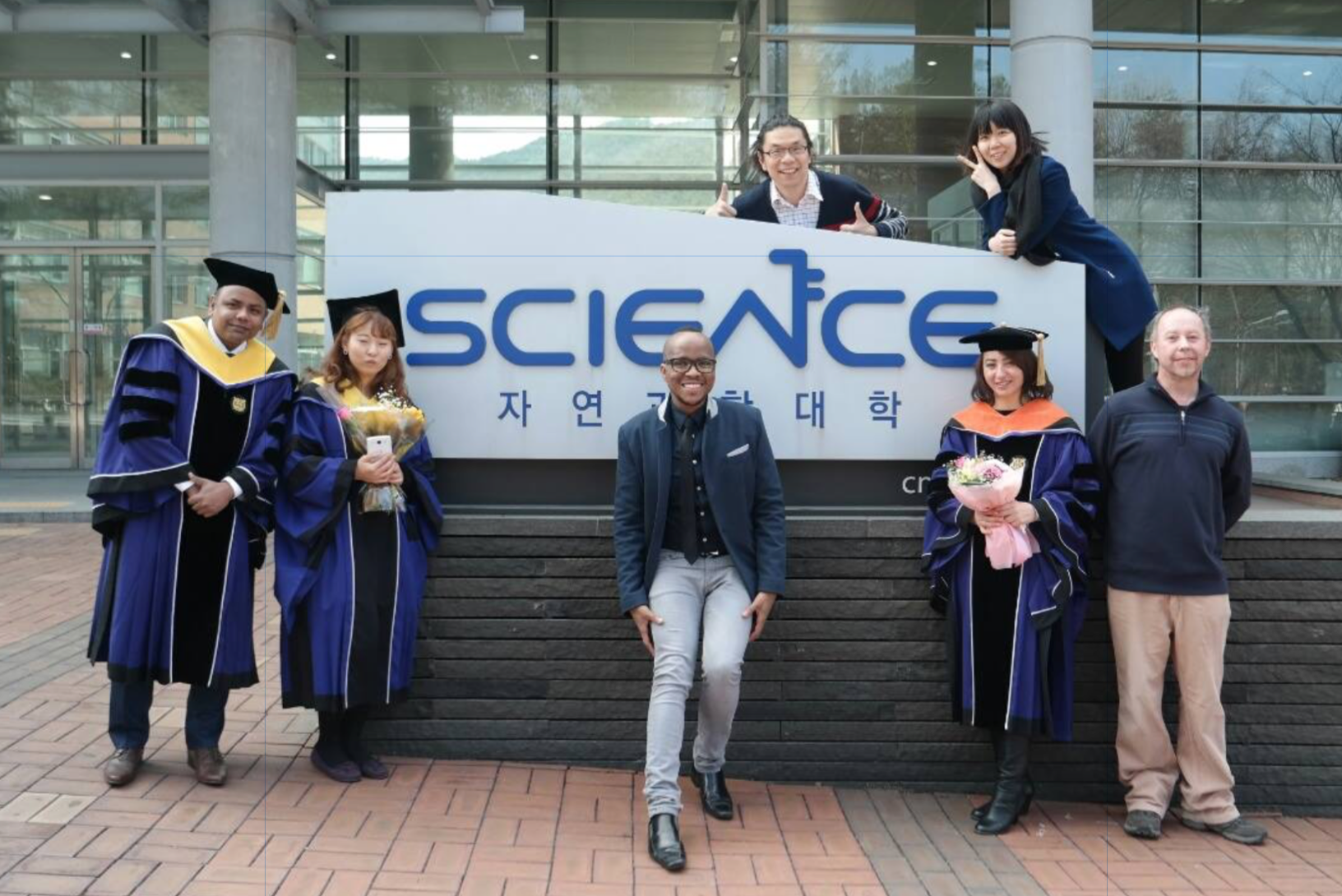
Graduation at Seoul National University

Upon graduation, I began to pack up my life once more and prepare to move to Canada where I would start my Ph.D. I must admit, I love everything about travelling: the airport, new cultures to explore, and — most important — the chance to make new friends. But, I have always said, “I came here with 1 bag and will leave here with 1 bag”. In principle, this rule would serve you well, but when you have lived in a new country for 2 years, you will accumulate stuff. Packing up your life into a 20kg bag arouses feelings of catharsis and reinforces the feeling of excitement about moving to a new place (out with the old, in with the new kinda feeling). Little did I know that moving to a ‘western’ country after being immersed in Asian culture would come with its own challenges, but that’s a story for another blog.


[1] The realisation that a bachelors degree will not suffice and guarantee the kind of job or future that you were day dreaming about during first-year.