The journey to step 1: choosing a PhD topic

By Dorothy Ngila


In 2009, I was interested in transboundary water management.


In 2010, that changes to something — anything! — about gender.


In 2011, it was all about mentoring of young girls and women in science and technology.


By 2012 and 2013, it was all about women in leadership in science and technology.


Would you believe it if I tell you that my final topic, and what I am now pursuing as my PhD topic is, ‘The role of academies of science academies as health science advisers: the case of Nigeria, Uganda and South Africa.’


So, how did this all come about?


For as long as I can remember (okay, lets rephrase that, for as long as I have been a post-matric student!), I have yearned for the day I would be called Dr Ngila. Part of it is because, I would be the first of my paternal grandmother’s grandchildren to attain this, and part of it because I think I have some innate pressure to follow in the footsteps of my aunt (who has also doubled as my mother for the last 15 years), Prof Catherine Ngila.


So there I was, having finished and graduated from a Masters programme in Geography and Environmental Sciences from the University of KwaZulu-Natal and settled into my job at the Academy of Science of South Africa (ASSAf) in Pretoria. The next logical step was to start my journey to a PhD.


I knew that I was passionate, disciplined and dedicated enough to pursue a PhD, but since 2009, I had toyed with way too many ideas.


But with my quest for trying to save the world (not literally but it’s been a hectic run at work over the last couple of years), and trying to figure out how I would fit a PhD in 3 years, I eventually settled into trying to get this done in 2015.


So how did I eventually choose a topic?


There were many, many concept notes…I kid you not, I read more than 200 scientific papers and produced no fewer than 20 concept documents in the last few years in my quest to finding the appropriate topic. In the end, however, my choice boiled down to three things.


  1. What kind of study

‘Will you full time or part time?’


I spent a lot of time thinking about whether I would leave my job and go into full time study or whether I should rather consider part time study. There are pros and cons to either but for me, it came down to the reasons for wanting to engage in PhD studies. If I wanted to have a PhD so that I could get into academia after completion, it was a no-brainer that I needed to go into full time study. However, I wanted to pursue the PhD for other reasons. It would boost my career development, enhance my critical thinking within the workplace, further my academic achievement, represent significant personal fulfilment, and contribute to building Africa’s knowledge economy outside of academia. I chose the part time route.


  1. Smart topics

‘Am I choosing a smart topic?’


For the last few years, I have been privileged to work in an array of portfolios within ASSAf. The ones that have truly spoken to my passions have been our African collaborations, and gender in science, technology and innovation. When I first discussed my desire to engage in PhD study to one of my mentors, she gave me the best nugget of wisdom ever, ‘choose a topic that is linked to the work that you engage in at ASSAf, as this will be easier to manage.’ This helped me to shape the topic I am working on right now. Regardless of how pressured the work is, every day, I read, have conversations, engage with topics that enable me to add value to the PhD process. Therefore, though I’m working a bit harder, mostly, I’d like to think I’m working smarter.


  1. The supervisors

‘They are renowned for their craft and are invested in the subject matter’


Once I had drilled down into the topic I was interested in, it became easier to find renowned scholars who were interested in promoting the PhD. They then helped me to shape the boundaries of the final research topic, ensured that my topic was relevant to my goals, and led me to the correct literature. For a part time PhD student (probably ALL PhD students), perhaps the most important decision that one can make is the choice of a supervisor. I have found supervisors who are not only understanding, supportive and invested in my completion of the PhD but also who give me important nuggets of wisdom on work/ life/ PhD balance (and let’s face it, I need this advice so much more as a part time student).


Many people will have different journeys into deciding on the PhD topic. What is more important is that you end up with a topic you are passionate about (but perhaps not too passionate), a topic that will endure the duration of study, and a topic that will contribute meaningfully towards your future career goals. Because mere curiosity is not going to sustain you through this PhD journey…

If you like it, put a ring on it…


By Davide Gaglio

Here we are again… I’m happy to let you know that I’ve survived my 3rd and final field season and I have plenty of photos to show you!

So, did you find it difficult to identify the prey in my last entry? The prey species were (2) Sole, (3) Pipefish (4) Anchovy (5) Squid and (6) Atlantic Saury If you have free time and feel like contributing to ecological research, I have tons of photographs that need identifying, and would love to use your help. Just email me (swift.terns ‘at’ gmail dot com) and we can chat about the possibilities. I believe that “Citizen Science” is an exciting way to bring people and wildlife together for conservation. Citizen-scientists can create the world’s largest research teams, gathering data on a scale that would be impossible to achieve otherwise, as these scientists are ordinary people all across the world, who are simply interested in helping researchers out. Trained scientists then analyse these data to understand how animals are affected by environmental change, including climate change, urbanization, pollution, and land use. Participants learn about their environment and have the opportunity to see their own data on maps along with those of thousands of other participants. Here’s an interesting example:

http://www.sanbi.org/sites/default/files/documents/documents/biodiversitybooklet2012barnard.pdf

From my point of view, getting involved in swift tern citizen science is a brilliant way of spending your free time 😉 Taking photos of the adult terns can lead you to great surprises…and discoveries. For example look at this image… can you see anything special about it?

tern in flight

Well, look closely at his legs….

tern leg close-up

Yes! This swift tern has a metal ring on the right and a red colour ring on the left. As you may know, the ringing of wild birds for scientific purposes has provided a wealth of information, revealing the life histories and movements of many different species. Read more about it here.

The ringing of swift tern chicks started in South Africa in the late 1970s already. This individual was banded on Marcus Island in 1979. At age 34, this is a new record for this species, confirming that like most seabirds, swift terns have great longevity! What a coincidence… the oldest swift tern ever known was the same age as me 😀 Now, imagine discovering a tern of even greater age than that. You can be the one!

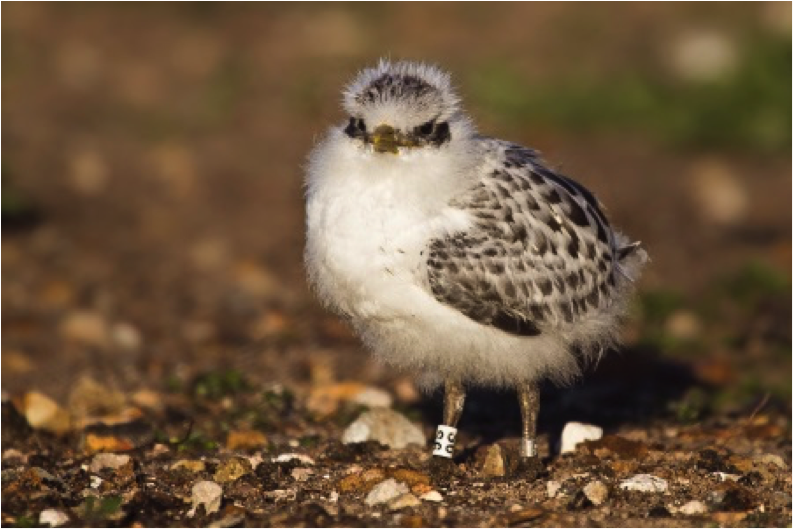
Ringing birds is a great way to study their survival and movement. It is crucial to ring birds to understand their population dynamics. As mentioned before, the difference between the terns and other local seabirds is that their population is increasing; another interesting dissimilarity is that they have extensive post-fledging care. Parents feed their chicks for several weeks after leaving the colony, during which time they can disperse long distances. So where are they going?? Here it’s my tu(e)rn again!!!…To better understand their dispersal; more than 1 500 chicks have been marked in Robben Island with engraved colour rings over the last three breeding seasons. Which means each individual has a unique code that can be seen from distance…and they look so cute! tern chick

I really had a lot of fun and great assistants over the last years during the ringing sessions. Thanks to all of you guys and girls!!

tern helpersHere some of my assistant’s projects:

https://sites.google.com/site/richardsherley/

https://sites.google.com/site/timotheecook/

So far there have been records of banded juvenile swift terns from Namibia to the Eastern Cape. Gathering dispersal records relies on the assistance from volunteers across southern Africa. And so here I need your help again… There are many immature/juvenile birds out there ready to be re-sighted by you! You can be the first to re-sight one of our banded birds in a new locality, just enjoy a walk on the beach and don’t forget your binoculars! Rings are orange, white or yellow (with black text) and green or blue (with white text). If you see any banded birds please record their location as accurately as possible (ideally GPS), the date and time of sighting, ring colour, letters on the ring (if legible) and age class (juvenile, immature or adults). tern teenagerIf a bird is found dead, please also record the number of the metal ring. Please send the information to me (swift.terns ‘at’ gmail dot com), and to SAFRING.

Your help is much appreciated!!!

Get inspired from this video.

I really hope to receive some exiting news from all over southern Africa…and I will be sure to update you soon 😉