The Birth of a Blogger

My name is Ijeoma (Ij for short), and I am a PhD Candidate in Political Science at Stellenbosch University under the South African Research Chair (SARCHi) in Gender Politics through the NRF scholarship. To have reached this point in my research journey required a lot of chopping and changing, but the golden thread remained the same – that I needed to write about what tugged at my inner core to answer questions that guided my being. As a young undergrad, I was drawn to International Relations because I was inquisitive about the world around me and the systems that governed the people who decided on them. My favourite subjects were history, social anthropology and metascience, as the questions of why within narratives and histories have always intrigued me. Throughout my journey in academia, I have been involved in extracurricular activities that mirrored it – I was President of the Stellenbosch Political Science Students Association (SPOSSA) in my final year while also being a media spokesperson for the Open Stellenbosch movement in 2015. Those activist spaces and experiences completely deconstructed what I saw as academia and the knowledge production created within institutions. It gave me the confidence to write on issues around me, and my education in activist spaces further shaped my writing as an Honours student. 

My Honours dissertation looked at Rape Culture through the lens of South African feminism. However, after receiving the Mandela-Rhodes Scholarship in 2017 and seeking broader experiences, I applied to the University of Cape Town (UCT) for a coursework MA in International Relations. During that programme, my interest in African politics deepened as I sought to research the experiences of West African migrants living in South Africa. Researching primarily on transnationalism theory, I was also exposed to other thinking within African feminisms, gender studies, and broader political science methodologies. Doing so gave me an educational experience that grounded me within International Relations, but with the capacity to think and write in an interdisciplinary manner. However, it was in 2021 that my freelance writing and blogging experience solidified. I started writing for a Stellenbosch zine called Say When, where I published my first freelance article on The Politics of Thotdom and Heauxism. This piece, to me, signified stepping outside the rigour of academic writing as I started familiarising myself with writing beyond the structure of introduction, body, conclusion and reference list. From there, I became more confident with trusting my voice and have been able to weave analysis with anecdotal writing, using the best of both worlds to share my viewpoints, thoughts and opinions on a range of topics with different styles of writing (series reviews, personal essays, prose, and more). For example, my first single-author journal article, published this year in AGENDA, was a poem I wrote on my experiences as a black woman in Stellenbosch. The idea that my creative output was acknowledged as a body of intellectual work encapsulates everything I believe:

The personal is political, and the political is personal. 

Bringing the ivory tower of institutions to a level that is accessible and understandable to others is something I am passionate about. My current PhD research is looking at unpacking slay queenism as a concept and using it as a lens to research black femme subjectivities in the South African cosmopolitan context. The overarching research areas involve understanding gender equality in South Africa and postfeminist iterations within a post-apartheid framework. 

My long-term plan is to occupy an intersecting space as a researcher, consultant, freelance writer and creative. Oscillating between these versions of myself as a writer, thinker, and creator is what sparks joy for me as a creative intellectual. Each path feeds into the other and informs how I like to stay in conversation with myself, my community, and the world around me. Being a blogger for SAYAS is a unique opportunity to highlight areas of academia I am passionate about (black feminist theory, gender studies) and would bring these topics to wider audiences whilst also destigmatising and educating broader populations about the ins and outs of being a foreign black woman researcher in South Africa.

Also, if you’re interested in following my academic journey or what I’m up to in my PhD journey, let’s stay in the conversation! I’d love to hear the topics you’re curious about and what you’d like to know about postgraduate studies.

🐦 Twitter

💼 LinkedIn

📷 Instagram

🌐 Website

🔏 Latest freelance articles

LESSONS FROM THE DEEP END

It’s been a long year, but it’s gone by in a flash. Endless, yet fleeting. Is it just me? I don’t think so.

I am experiencing a range of feelings as I prepare this final blog entry. Thomas Wilder once said, “It is hard to turn the page when you know someone won’t be in the next chapter, but the story must go on.” I suspect he was referring to me when he made this statement. It is difficult to imagine 2023 without the SAYAS blog community – the bloggers was a constant during 2022’s chaos. I have no words to adequately express my gratitude for your kindness and support.

I feel like I have been splashing in the shallow area of the pool for a very long time. When I finally transitioned from the shallow area to the real deep end of the pool in 2022, it was a significant milestone. Being immersed in academic life at first seemed weird, strangely alien, and even a little unsettling. I officially obtained my PhD in 2022, commenced my early research career, and entered the world of academia. And as the year went on, I adjusted and developed a degree of confidence I had never before imagined. And I love it. I don’t want to leave the water at any point. 

When I consider 2022 and the lessons I acquired from navigating my way between the shallow end and the deep end of the pool, three important survival skills come to mind:

#1 – Getting comfortable in the deep water:

Being in the deep end initially felt uneasy and even made me a little anxious. DuPage Swimming Centre writes that one must spend enough time in the water to become accustomed and develop confidence. This year, I’ve realized that even though l enjoy spending time in the water, it could also be draining and full of unpleasant surprises. At times, I make the necessary preparations, get ready, meet deadlines, and then get surprised by what may end up being a lengthy, major delay brought on by circumstances that are beyond my control. Combining this “hurry-up-and-wait” approach with one of those all-to-familiar “try, try, again” (and again, and sometimes again) scenarios can often be demotivating. During these experiences, many students, researchers, and academics simply get out of the water.

However, the Aquazone blog cites the advantages of staying in the water, and I wholeheartedly concur. Even though it may be more difficult to stay motivated on such days, it is all about the journey. I believe that these difficulties are merely moments (mosaic fragments) in the grand scheme of things. Our abilities and confidence will keep improving as long as we feel at ease in the water and keep swimming.

#2 – Celebrating successes

The Hubbard Family Swim School blogs about the value of celebrating swimming milestones and adds that all accomplishments should be recognised. In a similar vein, I think we ought to acknowledge our academic achievements more frequently. Being a postgraduate student, early-career researcher, or academic is challenging in and of itself, and is sometimes accompanied by thoughts of imposter syndrome and self-doubt. However, we still persist, come what may.

If I were to compare myself to the person I was five years ago, I would see that hard work pays off and that both my personal and professional life had changed and grown. If you were to compare your current state with that of a version of yourself from five years ago, I’m fairly confident that you would report the same. It’s okay to sometimes need more time to solve problems. But, we should not be so hard on ourselves and be proud of how far we have come.  In this ever-changing era, we need to own our journey and celebrate success.

#3 – Don’t swim alone

My mind is shifting to all the books and films, where friends are drifting in the pool, sipping mojitos, and enjoying each other’s company!

When I started on my academic, research and blogging journey, the last thing on my mind was to make friends, or to form part of a community. It’s not that I did not want to make friends, it’s probably more of a goal-orientated thing. Almost a year later, my mindset shifted to the point where networking became a vital part of this process. I’ve learned that academia can be very alone and that relationships among academics can strengthen each other. Scientific careers shifts over time, attracting individuals of all ages, abilities, talents, and motives, there are a wide variety of individuals who can swim with you.

 Although being vulnerable and peeking into this new world can be difficult at times, doing so can open up a whole new world for you. Rockhampton Aquatic explains that swimming with others keeps you accountable, fosters relationships, is great for socializing, and challenges you while you pick up new abilities. Never again will I go swimming alone!

I will carry these three lessons with me into 2023 because they have been so meaningful to me. As we enter the FESTIVE SEASON, I hope all of you will enjoy the break from work and school. Natalie Theodosi claims that this time of year is also used to pause, take stock of, and delve a little deeper into our own experiences. Whatever this time is for you, I wish you all the very best.

Lastly, hang in there, everything will be fine! Good luck with your studies, and your work. I’m rooting for you.

Best

Luce. Someone like you.

(with a lot of sparkle)

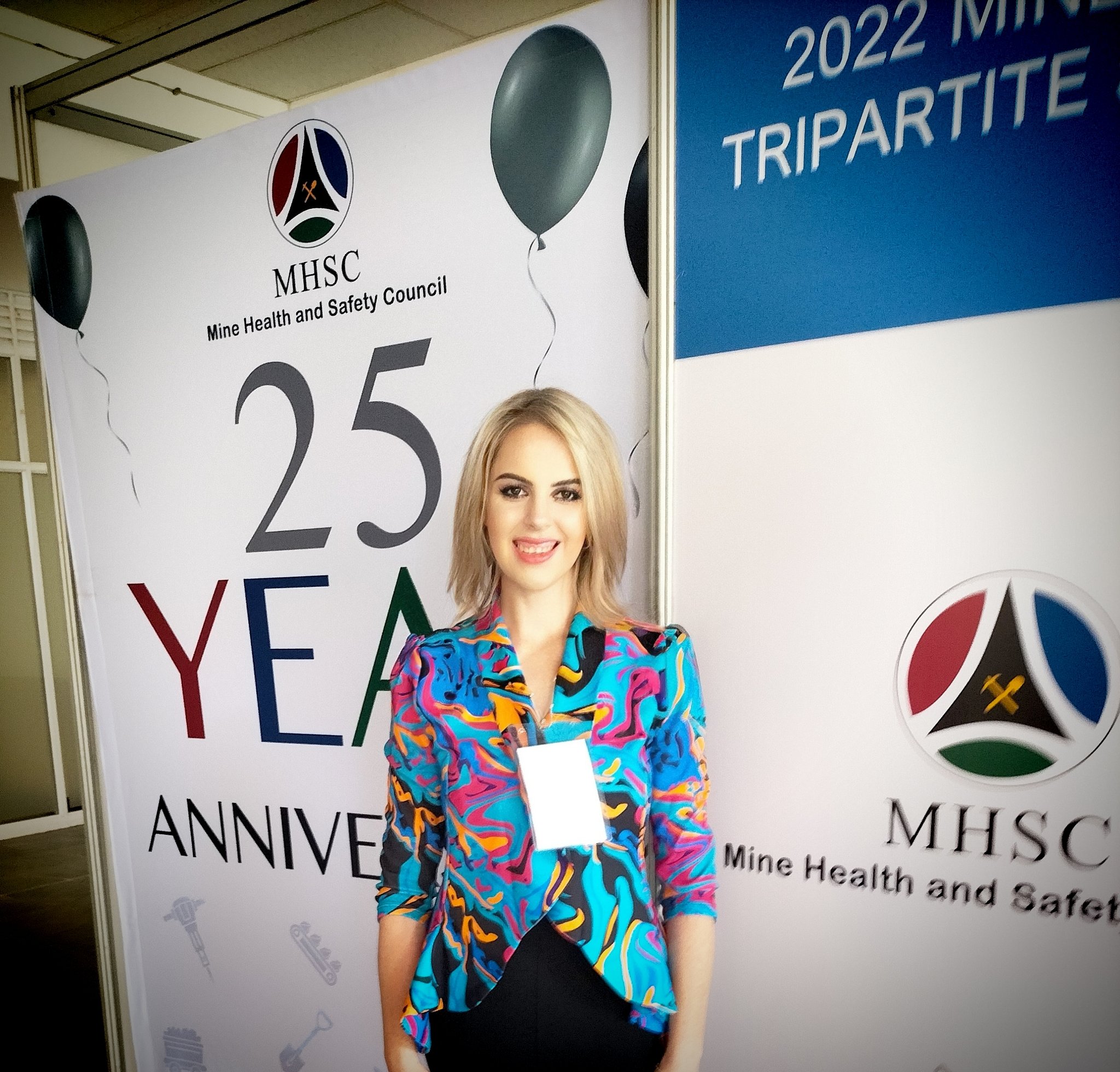
Luce Pretorius at the Mine Health and Safety Council (MHSC) Tripartite Summit where she presented a session on mental health in the workplace.