I’m not generally into watching sports. In fact, most of the time, I cannot get myself follow what’s happening on the screen, even if I try. Somehow, this drastically changes when the football world cup (or, alternatively, the Euros) reaches its zenith. When playing ball turns into a zero-sum game, I am suddenly really invested! But only if I have people around me how are supporting their team of choice vehemently – not once have I managed to motivate myself to watch a game on my own.
My mom discovered her passion for watching soccer games later in life and can tell you everything about her favourite team, Borussia Dortmund. When there are any bigger soccer games shown on German public TV, you can be sure she’s watching. Unlike my dad, who could not care less – so much for gender stereotypes! I think it’s because of emotions running high that I also end up getting excited to the extent that I scream at the TV when it comes to all-or-nothing international matches, I even though I’m not actually an enthusiast of ANY sports.
It may sound weird, but there is something really transfixing about a team trying so visibly hard to claim relevance (and a substantial price), watching them jump on each other overcome with pure joy and grown men in the audience not ashamed to have their tears being documented – something they might not feel free to do in other public contexts. I bet my grandfather shed one or the other tear as well when he religiously attended the semi-monthly games of the relatively small football team of my hometown in Germany, Offenbach (the team’s name is Offenbacher Kickers, in case you were wondering).
Even though it was sometimes bothersome living in Germany during the big football competitions, the car-hooting and late-night shouts of jubilation in the streets were somewhat infectious. It is worth mentioning that this typically only happens when male teams are playing, which tend to serve as the implied default-gender when speaking about the sport (a quick Google and image-search of the term ‘German national team’ will demonstrate this default-thinking). This is despite the German women’s national team, for instance, being highly successful and ‘women football’ having achieved record viewership in 2020 because of new broadcasting and streaming deals. But let’s bracket that for now.
I do quite fondly remember the (men’s) world cup in Germany in 2016, when, for a moment, it felt as though coming together to watch football was the only thing that mattered. I was working at a Burger King outlet at the main train station in Frankfurt at the time. Watching dressed up and cheerful fans throughout the workday made me smile and was a much welcome sight breaking with the mind dulling routine of selling burgers. It was also the first time that it was widely acceptable to ‘show flag’ again in Germany after the second world war. While I’m critical of expressions of national pride (as they tend to imply the exclusion of others) and was worried that the situation will somehow turn hostile, I recall this period to have been mostly light and cheerful.
And then, of course, there was the (men’s) World Cup 2010 in South Africa. I had been to Cape Town a couple of months prior for an internship and was planning a semester abroad at the University of Cape Town at the time, which turned into a permanent move. Given that, I was following the coverage around this World Cup especially closely on TV. The sensation of a momentary feeling of togetherness communicated through celebratory images made it all the way to my couch and got me exhilarated. The feeling was overpowering, even though it was fleeting and interspersed with news coverage about the financial spending South Africa had to undertake to be able to host the tournament, and how this compared the country’s other urgent investment needs.

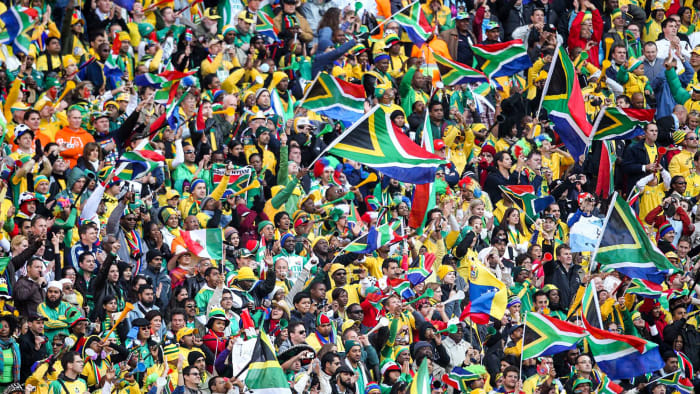
I have long been somewhat intrigued by how watching sports brings people together on the one hand and, on the other, serves as a platform for violence (again, as far as I know this is not typical for any ‘women’s sports events’). In the shape of sheer hooliganism, the latter seems incomprehensible if thinking of football as a mere ball game, especially when caught up in a beautiful moment. But it is indeed much more than that – it’s an intrinsically social affair. It is a microcosm with its own dynamics, a space with its own rituals in which everyday social rules become amended. And one that I cannot help myself getting sucked into when surrounded by football enthusiasts.
I imagine that, in one situation or another, we all might be susceptible to let ourselves float as a part of a group dynamic that emphasise commonality, nurtured with each burst of emotion. Given how dependable we as humans are on one another, having amplified responses to a tangible shared sense of vulnerability is not all that surprising from the perspective of an anthropologist such as myself. But it’s still remarkable and quite obviously something I’m not immune to. As already mentioned, the unfortunate part of the story is that where there is demarcated inclusion, there are usually also markers of not-belonging. When excitement peaks, these run the risk of being escalated. Such was evident in the aftermath of the Euro final. Footballers of the English team who were cheered on by the masses on the field found themselves racially abused online following their team’s defeat (a ubiquitous rather than an exceptional phenomenon for Black players).
Where there are moments of sheer thrill, these are not bound to last. A mere day after the Euro final, all its intensity had completely worn off for me. And whomever stranger one had ended up hugging and crying with in the audience of a stadium, one may keep their distance from the next day when meeting at the supermarket. But there is always a next time to get that intriguing rush of raw, unfiltered human expression. Hopefully minus any potential elements of aggression.
 SAYAS BLOG