Palesa Molefe
“Human, what?” he paused, mid-chew of the pasta in his mouth.
“Human biometeorology,” I said, chuckling at the expression of confusion that spread across his face.
He blinked and tilted his head, staring at me with concentration. “Sounds like something between sci-fi and weather forecasting”, he shrugged.
“Close!” I grinned. “It’s the study of how the weather and environment affect people in different spheres of life. Whether it’s health, tourism, or thermal comfort. Think of it as the bridge between meteorology and other scientific disciplines. With a human twist.”
That’s usually how most of my conversations go when people ask about my research.
What is My Research?
My MSc research sits right in the middle of the fascinating field of biometeorology; looking at the risk of heat stress in medical practitioners working in the emergency department of a government hospital.
It may sound niche, but it touches on something that affects all of us, especially as our climate continues to warm. It examines how our bodies cope with heat, especially when we’re working in high-stress, high-pressure environments.
The Emergency Department: A Heat Trap in Disguise
When we think of hospitals, we usually imagine sterile, air-conditioned halls and state-of-the-art equipment. But that image doesn’t always align with reality, especially in South African government hospitals that are often overburdened and under-resourced.
Now, zoom in on the emergency department. It’s a pressure cooker. Figuratively and, at times, literally.
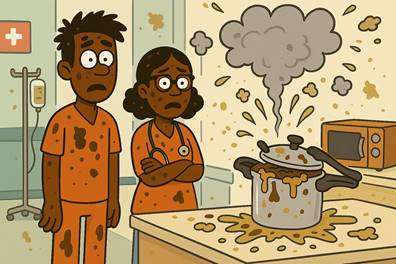
When hospital heat stress and workplace pressure collide, even the lunchroom cannot survive under this pressure. (Image created with the help of ChatGPT Open AI).
Doctors, nurses, and support staff are constantly on their feet, making critical decisions, attending to trauma cases, and navigating overcrowded rooms, all while wearing personal protective equipment. Add poor ventilation, high patient turnover, and South Africa’s increasingly hot climate, and you get a perfect storm for occupational heat stress.
So this is the question: What is the risk of heat stress in healthcare in such a busy environment, and what can we do about it?
Why Human Biometeorology Matters in a Hospital
This is where human biometeorology comes in. It’s not just about tracking temperatures and humidity. It’s about understanding how those conditions interact with the human body. Specifically, it’s about how heat exposure affects heart rate, core body temperature, concentration, and even decision-making abilities.
My research explores these relationships in real-time hospital settings. Using tools that measure indoor temperature, humidity, radiant heat, and air movement, I will assess the thermal comfort and heat stress risk for emergency department practitioners. I plan to gather data on their experiences during their shifts.
The goal? To combine objective environmental data with personal experiences to build a fuller picture of how heat stress manifests in real-world clinical environments.
Climate Change Isn’t Just an Outdoor Problem
One of the most surprising insights I’ve had during my postgraduate journey is how climate change is not just an outdoor problem.
We often focus on farmers, construction workers, or athletes when talking about heat risk. Just like outdoor spaces, indoor spaces can be just as hazardous, especially when they lack adequate cooling systems or airflow. This is often the case in our public health facilities.
And when heat affects medical professionals, it’s not just their health that’s at stake. The quality of healthcare they provide to patients can be compromised. The risk of heat stress not only affects outdoor labourers, it also affects all other professions. Just a little differently.
The beauty of research like this is that it doesn’t just point out problems. It can also help spark solutions. I will explore these deeper as I conduct my research.
Back to the Pasta Bowl
“So, you’re basically making sure doctors don’t melt while saving lives?” he said, finally swallowing his pasta.
“Exactly,” I nodded enthusiastically. “They take care of us. The least we can do is to make sure their work environment doesn’t burn them out. Literally.”
He raised his fork in salute. “I’ll never look at a hospital the same way again.”
And honestly? That’s the point. If one conversation over pasta can shift someone’s perspective, then imagine what awareness, research, and action can do on a larger scale.
After all, human biometeorology may sound like a mouthful. At its core, it’s about keeping people safe, healthy, and thriving. Even under pressure. Even in the heat.
Note: The headline image of this blog post was created with the help of Canva.
 SAYAS BLOG