Earlier this year I was having a conversation with a colleague around the advances and progress that has been made in the scientific world over the years. As the conversation evolved, we became curious about more than the science from textbooks and laboratories that’s never actually applied in the real world where Mr and Mrs Civilian would benefit from it. As we looked into the application of research in the real world, I was in awe at what Asians have been able to accomplish over the years and how much advanced they are already in terms of science and technology. This amazement ended there in that office on that day; until I started to prepare the literature review for my own research a couple of weeks ago.
 Asian countries – China, Japan, even Korea, Taiwan and India – appear to dominate ecotoxicology. I am on the internet everyday compiling papers and it seems every time I get a relevant published study to my work, it has been done in China or Japan. I am not sure if it is because of a national love for the environment, their technological advancements or if pollution is simply so excessive in Asia that researchers HAVE to try to fix the problem. But the top ten most polluted countries are not only in Asia. Some African countries have made it to the list, yet there is hardly anything in literature about their work. Which begs the question, are we scientifically ignorant, or are we just pretending that we do not care about the environment?
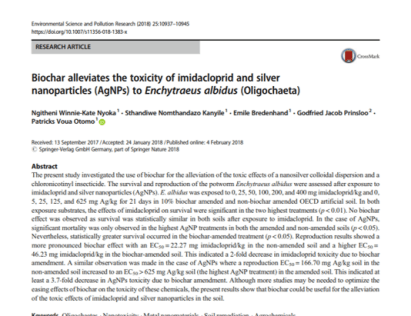
I don’t mean this in a judgmental way – it was just so difficult to find traces of African research in my field. But I kept on looking. There seems to be quite extensive work done raising awareness through conferences and weekly blogs that focus on the environmental work in Africa. Some prominent scientific work has also been done in countries like Nigeria and Kenya as well. Much to my amazement, Eastern Cape universities such as Rhodes University have played a prominent role in the assessment of the aquatic systems and ecotoxicological work through their Unilever Centre for Environmental Science. The CSIR has also had quite a field time especially in the assessment of the wastewater works. And I was excited to read an article on Environmental Science and Pollution Research by a colleague of mine. It really is amazing how far we have come in the past decade.
My argument, however, is that we still have a long way to go in establishing our footprint in the field of ecotoxicology. Yes, perhaps Asian countries have better technology, easily accessible funding and resources. However, at the moment there are hefty amounts of money being funnelled into the development of the African research. The few that I am personally aware of include the International Foundation for Science (IFS), REACH, IDRC, BRICS grant and DFG. As South Africans and Africans in general, we can use these opportunities to establish our footprint in the research that will benefit us and future generations. And then, we still have a long way to go in not only doing research but also in communicating our results to the general public and actually implementing the solutions that we find in the lab.
 SAYAS BLOG