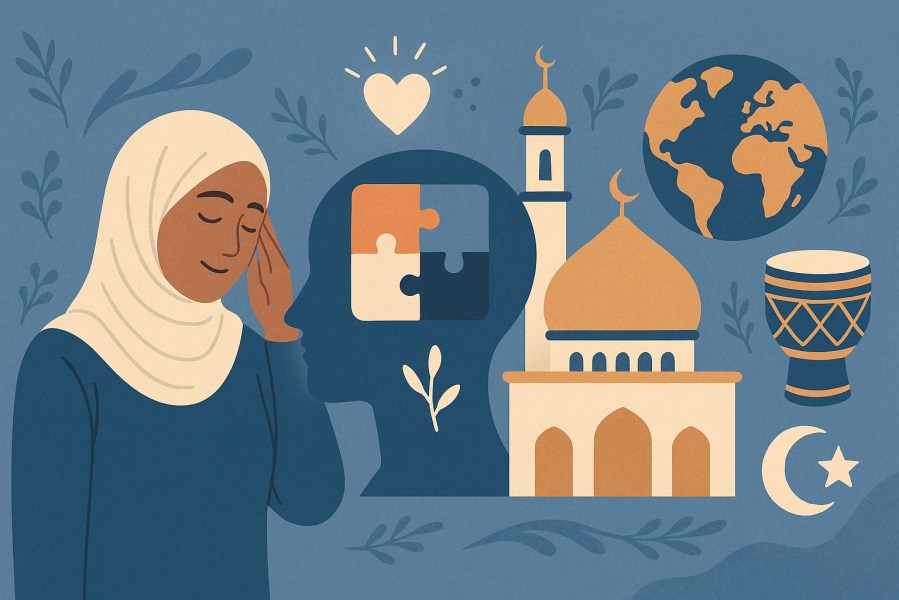
A Conversation about Culture, Muslims and Mental Health

Mariam Salie

My first-year anthropology lecturer once said: “There are as many cultures as there are people in the world”. I am inclined to agree with him. My PhD study explores the explanatory models of mental health conditions amongst Muslims through a multi-stakeholder approach. My work and I are inspired by Arthur Kleinman, a medical anthropologist, who coined the term ‘explanatory models’. Explanatory models refer to people’s beliefs, attitudes, understanding, and symptom and treatment knowledge about any given condition. That was a mouthful but stay with me.

Kleinman believed that it was important to construct a cultural formulation of illness based on the information noted above. According to Kleinman, people’s beliefs and perceptions about their health conditions are important to consider as it can improve the patient-practitioner relationship. The improved relationship contributes positively to treatment adherence, thereby improving treatment outcomes. A win for all! There are many others, like me, who have started to engage seriously with conversations around cultural competency, cultural relevance, cultural sensitivity, or cultural humility – whichever term tickles your fancy. The bottom line is the intersection of culture and mental health is an important one!

For my PhD, four stakeholder groups will provide the data. These stakeholder groups are: 1) Muslims with lived experience, 2) general Muslim public, 3) psychologists who have treated Muslims, and 4) Muslim clerics. While I would love to share everything I have learnt, I will save that for the PhD publications. What I would like to draw attention to in this post is two things: 1) culture and religion are often conflated and this impacts the mental health experience, and 2) mental health is understood through a cultural lens perhaps more than we realise.

First, religion is often perceived to be a part of culture, and some cultural practices are embedded within religion. Teasing apart culture and religion is a challenging task, and more often than not, their boundaries blur in ways that make clear distinctions difficult. I have witnessed this conflation first-hand in my practice as a clinical psychologist, as well as in my research. These experiences have demonstrated how cultural practices are often perceived with religious significance which has implications for how mental health is experienced, as well as whether help is sought appropriately. Cultural practices also establish rigid rules by which the community must abide, and any deviation is seen as deviating from the religion. Pertaining to Islam, I have now learnt after engaging with Muslim clerics on the matter that many of these cultural practices and cultural constructions have, in fact, nothing to do with Islam. Islam promotes holistic health which acknowledges mental health as an important component of overall health and wellbeing. Interestingly, recent literature has highlighted historical Muslim scholars who wrote extensively about mental health, as we understand it today. See Dr. Rania Awaad’s work, amongst others.

This brings me to the second point – how mental health is understood through a cultural lens. I cannot speak for all cultures or religions, but my work in the Muslim community has highlighted how mental health has predominantly been understood through a cultural lens. These cultural constructions of mental health have largely influenced perceptions about mental health and have contributed to the continued stigmatisation of mental health conditions (MHC) in the Muslim community. There are several problematic perceptions about MHC. Firstly, and most notably, there is the perception that MHC are non-existent. Conversations on the topic are taboo, and the cultural norm is to endure any kind of hardship. Secondly, MHC are sometimes perceived to be an indicator of ‘madness’ and people who are treated for these conditions are often alienated, feared, and treated with disdain. An interesting experience for me was the feedback I received from many participants. They thought I was ‘quite brave’ to explore this topic in the Muslim community and regarded the study as important but were also quite cautious about participating openly. During the focus groups, participants opted to keep their cameras off and use pseudonyms.

My work as a clinical psychologist in the Muslim community gives me a different perspective so it was interesting to engage on this topic through a research lens for my PhD. It is apparent that while more Muslims are seeking formal mental healthcare, stigma is still very much alive and thriving in the broader community. And dare I say it; it is the cultural constructions associated with mental health that continue to feed the stigma. Why is this conversation important? South Africa is a diverse nation and if we are serious about decolonising our practices (in whichever discipline), we need to understand how South Africans make sense of their experiences and collaborate with them as experts on their own lives.

Decolonising Theory: Breaking through the Invisible Wall

Keleabetswe Rabalago

15 years after my exposure to the political ideology of Black Consciousness, I feel like I am closer to realising my dream of contributing to the formation of African Psychology. A dream sparked by the need to understand the alienation that I felt coming face-to-face with the culture I was born into. A feeling I had no word for until the 3rd year of my BA study, reading a book titled The World Looks Like This From Here. Fired up by the possibility of a psychology that recognises the collective wounds borne of an oppressive past, I started my Master’s journey with my sleeves rolled up, ready to work. As soon as I walked through the metaphorical door, to my pleasant surprise, I was met by academics in the social sciences up in arms. Saying enough is enough! For how long will they be fed and be made to feed coloniality in the form of education?

In a refreshing new wave of academic decolonial activism, the past decade has brought new literature, social organisations, and business models that aim to address the coloniality of these contemporary times. Social science academics are crossing the invisible barrier line between academia and the society in which it exists, addressing issues of epistemology and methodology. From the various fields of the humanities, scholars are calling for a decolonial approach in theory and praxis.

Coloniality is a concept that describes colonial-like power relations that are invisible in modernity. Coloniality is a product of an incomplete struggle against historical colonialism, a system of oppression that involved land dispossession, labour and resource exploitation, and repressive laws. This system was characterised by the dehumisation of the people who were colonised, which was achieved through physical and psychological violence. Academics were commissioned to conduct research that justified the dehuminisation, theoretical frameworks were developed and science “proved” that some people (the colonised) were less advanced than others (the colonisers and beneficiaries of colonialism), thus they were incapable of participating in society as full humans. In this setting, academic researchers placed the colonised people under the microscope (literally and metaphorically), making them a subject of study, treating them as data points and never as people who produce knowledge. Through this process, the “othering” of the colonised people was further cemented, creating invisible barriers between the coloniser, colonial beneficiaries and the colonised people. Coloniality is the continuation of this system in contemporary times, colonialism reformed as modernity; one of the ways in which it manifests in academia is epistemic superiority and academic rigour.

Decolonial theory enables researchers and “non-scholars” to see the invisible thread that connects modernity to historical colonialism. Decolonial scholars argue that, in the  process of liberation, the struggle was primarily against visible colonialism — exploitation, violence, repression etc. — but the process did not destroy colonialism as a system of power. One of the major criticisms leveraged against modern  hegemonic epistemology is that it disregards other ways of knowing and claims to be the only system capable of producing valid and universally applicable knowledge. Decolonial scholars argue that there are multiple realities, and knowledge production is not a capability reserved only for dominant groups and systems; knowledge is pluriversal. Furthermore, hegemonic knowledge itself is a product of and for a specific context, and may not be universally applicable and appropriate to a different context.

An additional criticism laid against modern hegemonic epistemology, is the method of knowledge production; it is extractive, exploitative, and distant. Within this method of knowledge production, previously colonised places are seen as data sites, much like Africa was (and still is) seen as a resource site to be mined of its raw materials for processing and packaging elsewhere. This means that the extracted data are most likely to be interpreted and understood in a decontextualised way, separated from its original source and meaning. Furthermore, the results benefit the researcher (with academic recognition) rather than it does the people that participated in the production of knowledge.

Decolonial theory, specifically decoloniality, addresses the abovementioned problems. First, decolonial scholars argue that knowledge is contextual and that its context should be stated to allow visibility of its shortcomings in different contexts. Secondly, knowledge production is not and should not be produced and validated only by hegemonic institutions. It recognises that theorisation happens outside the borders of hegemonic institutions as well, therefore locations outside the institutional borders should not be approached as sites for data collection only, but as sites that produce knowledge. Furthermore, data should be analysed and understood within that knowledge system. Lastly, and importantly, researchers should invest their time and resources in supporting the communities where they conduct their research. This is especially important for researchers that focus on addressing issues of the remnants of colonialism. Decolonial theory calls for an egalitarian epistemology and approach to knowledge production.

Decolonial scholars recognise that coloniality, just like colonialism, will not go away on its own or “fizzle out”. Its eradication requires critical conscientisation of the problematic system, developing new theory for analysis, and collectively acting for transformation.

Note: The headline image of this blog post is a picture I took in 2024 at the Zeitz Museum of Contemporary Art Africa (MOCAA) in Cape Town, South Africa.